
Your stackable washer and dryer leaks between units because water is escaping from a connection, a hose, or the washer’s tub before it ever reaches the drain, and the narrow gap between the two machines is simply where gravity carries it into view. The leak rarely starts in that gap. It shows up there because that’s the lowest visible point between two machines stacked tight against each other, with almost no room to look around.
It’s an unsettling thing to find, especially in a stacked unit tucked into a closet or a small laundry nook, which is exactly where these setups tend to live in Michigan condos, apartments, and older homes with tight floor plans. You hear dripping, or you notice a damp patch on the floor in front of the closet door, and there’s no way to see what’s actually happening back there without pulling the whole thing apart. Before you do that, it helps to know what’s usually causing it, because most of these leaks trace back to one of a small number of repeat offenders.
At Motor City Appliance Pros, stacked units are some of the trickiest calls we get, not because the causes are unusual, but because everything is crammed into a space that was never meant to be serviced easily. This guide walks through where to look, what each type of leak tends to mean, and when it’s worth calling in help rather than pulling a 150 pound stack apart yourself.
Why Stacked Units Leak More Often Than Side by Side Machines
A side by side washer and dryer give you full access to hoses, vents, and connections from the back or the sides. Stack them instead, and everything gets compressed into a few inches of clearance, often inside a closet with barely enough room to open the doors all the way. That tight fit isn’t just inconvenient for repairs, it actually creates more ways for water to escape.
The washer vibrates during the spin cycle, and in a stacked configuration that vibration transfers straight up into the dryer sitting on top of it, which loosens fittings over time in a way a floor mounted washer never would. The stacking kit itself, the metal bracket that holds the dryer securely on the washer, has to carry that vibration without letting the two units shift apart. And every hose, vent, and cord serving the top unit has to be routed cleanly through or around the bottom one, leaving less slack and less forgiveness if anything sits at a slight angle.
Check If the Whole Stack Is Actually Level First
Before chasing individual parts, it’s worth confirming the basics. A washer that isn’t sitting level is one of the most common root causes of a stacked unit leak, and it’s also the easiest thing to check and fix.
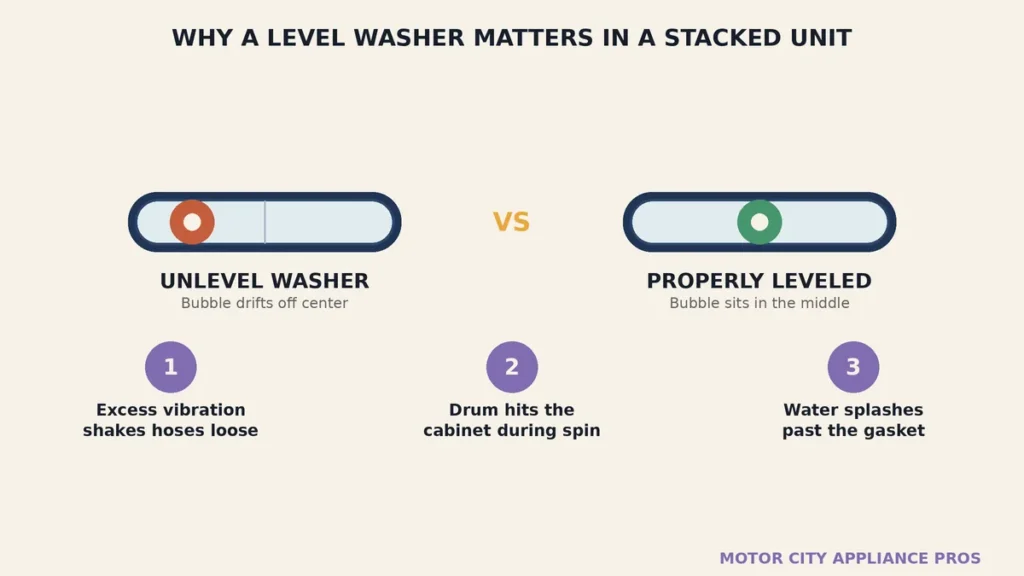
Most washers have a small bubble level built into the top of the cabinet, or you can set a standard level across the top panel. If the bubble sits noticeably off center, the machine is tilted, and that tilt causes a chain reaction. An unlevel drum spins with extra vibration, which can shake supply line fittings loose over dozens of cycles. It can also cause the drum to strike the cabinet slightly during high speed spin, flexing seals that were never designed to move that way. And in some cases, an unlevel machine simply lets water splash past the door gasket because the tub isn’t sitting square underneath it.
Checking this takes two minutes. Adjust the leveling feet at the bottom of the washer, usually by hand or with a wrench, until the bubble centers and the machine doesn’t rock when you push down on each corner. If your unit sits on a raised pedestal, check that the pedestal itself is level too, since a tilted pedestal defeats a perfectly level washer sitting on top of it.
Look at the Stacking Kit Itself
The bracket connecting your two machines isn’t optional hardware, even though some installers skip it to save time. A proper stacking kit does two jobs: it locks the dryer to the washer so vibration doesn’t walk them apart, and it maintains a small, sealed gap between the units so nothing from above drips straight down onto electrical connections or vents below.
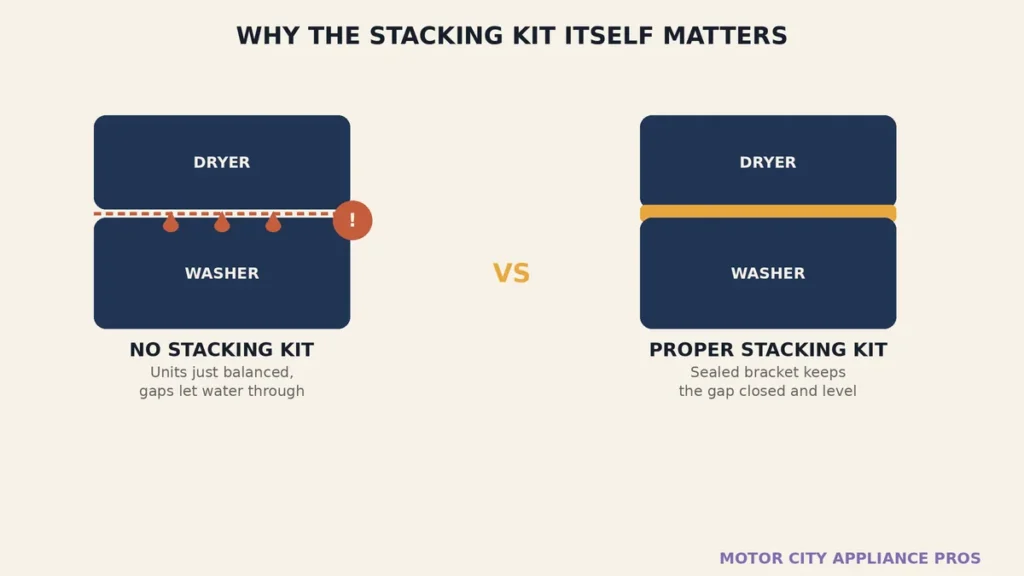
If your units were stacked without the manufacturer’s kit, or with a universal kit that doesn’t quite match both machines, that gap often isn’t sealed at all. Water condensation from the dryer, or splashing from an overfilled washer, can travel straight down through an open seam between the two cabinets. This is one of the more common issues we find in rental units and older installations, where a previous owner or a quick move in job skipped the proper kit entirely. If you’re not sure whether yours is installed, look at the seam between the two machines. A proper kit leaves a tight, even gap with a bracket visible on both sides. A missing or mismatched kit usually leaves a visible wedge, wobble, or uneven gap you can rock by hand.
What’s Actually Behind the Stack
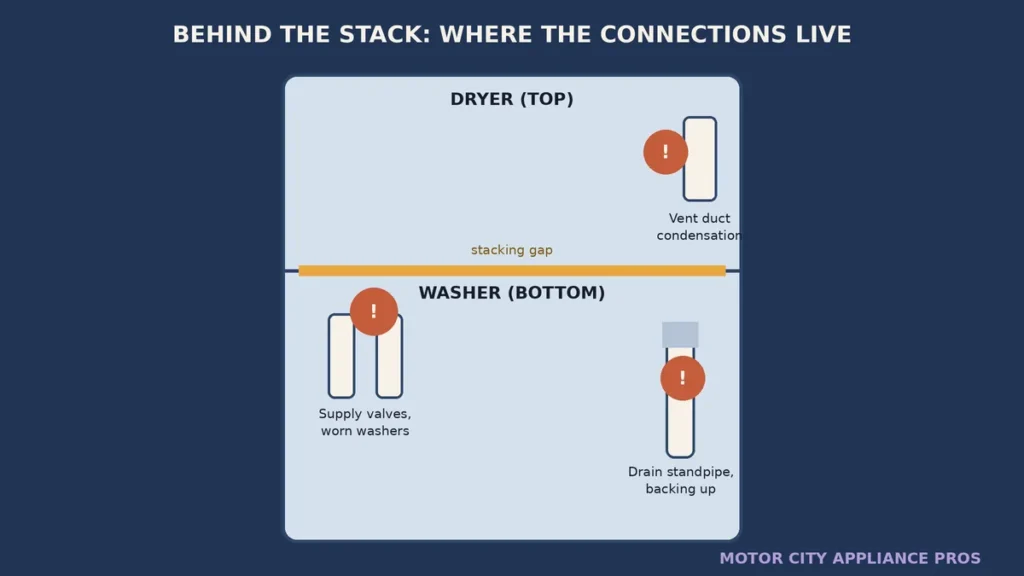
If the stack is level and the kit is properly installed, the leak is coming from one of a handful of connection points hidden behind the units. None of these are visible without pulling the stack away from the wall, which is exactly why they go unnoticed until water has already made its way to the floor.
Worn Supply Line Washers and Loose Fittings
The rubber washers inside your water supply hose connections harden and crack with age, and vibration from a stacked unit accelerates that wear compared to a floor mounted machine. A slow drip at a supply connection can run for weeks before it’s visible, since it tends to travel down the inside of the wall or cabinet before finally showing at the base. If you can reach behind the unit, check both hot and cold connections at the wall and at the back of the washer for dampness, mineral crust, or a greenish tint on copper fittings, all signs of a slow ongoing leak.
A Failing Drain Hose or Overwhelmed Standpipe
Water leaves the washer through a drain hose that usually empties into a standpipe in the wall. If that hose has slipped out of the standpipe, even partially, water can spray out during the drain cycle instead of going where it should. An undersized or partially clogged standpipe causes a similar problem in reverse, backing water up faster than it can drain and forcing it back out around the hose. This tends to show up specifically during or right after the spin cycle, which is a useful clue if you can time when the dripping happens.
Dryer Vent Condensation
It’s easy to assume a wet spot near the stack has to come from the washer, but a poorly vented dryer produces plenty of moisture too. A long or improperly sloped vent run lets humid air condense inside the ductwork instead of escaping outside, and that water can run back down the duct and drip near the connection point at the back of the dryer. This is worth ruling out separately, since fixing a supply line does nothing for a vent problem, and vice versa.
A Cracked Tub or Failing Door Seal on the Washer
Less common, but worth checking if everything else looks fine, is damage to the washer itself. A hairline crack in an older plastic tub, or a door boot gasket that’s torn or pulling away from its mounting, can leak steadily during the wash and rinse cycles. This usually shows water appearing during the fill and wash portion of the cycle rather than only during the spin, which helps separate it from a drain or vent related cause.
Narrowing It Down by When the Leak Happens
Timing tells you a lot, and it costs nothing to pay attention to. If water only shows up during the fill or wash portion of the cycle, look at supply connections and the door seal first. If it only appears during or right after the spin cycle, focus on the drain hose, the standpipe, and whether the unit is level enough to avoid drum strike. If the dampness seems to build slowly over hours or days with no clear connection to a specific cycle, dryer vent condensation or a slow supply drip are the more likely suspects.
It also helps to run a load with nothing but water and watch what you can see of the connections from the front, using a flashlight and a mirror if the closet is tight. You won’t see everything, but a supply line spraying visibly at the wall connection is often obvious even from a partial view.
Why This Trips Up Michigan Renters and Condo Owners Especially
Stacked units are common in exactly the kind of housing that’s common across Michigan cities, condos, apartment buildings, and smaller homes converted for more efficient use of space. That combination brings a few extra wrinkles. Many stacked units in rental properties were installed by a previous tenant, a landlord’s handyman, or a mover, not always with the correct kit or with hoses cut to the right length for that exact model pairing. If you’ve just moved into a unit with a stacked washer and dryer already in place, it’s worth doing a level and kit check early, before a slow leak has time to damage flooring or a downstairs neighbor’s ceiling.
Cold Michigan winters add another factor for condensation related leaks. Dryer vents running through unheated spaces, like an unconditioned utility closet or an exterior wall, see a bigger temperature difference between the warm moist air leaving the dryer and the cold surface of the duct, which increases condensation compared to a milder climate. If your leak seems worse in winter and nearly disappears in summer, the vent is a strong suspect.
What to Do Right Now if You Find Water
Shut off the water supply valves behind the unit if you can reach them, and unplug or avoid running the machines until you’ve identified the source. Running a load while actively leaking risks a bigger mess and, if the leak is anywhere near an electrical connection, a real safety hazard. Mop up standing water quickly, since it can wick into surrounding flooring, drywall, or a downstairs ceiling faster than it looks like it should, especially in a closet with limited airflow to dry things out.
If you rent, tell your landlord or property manager as soon as you notice it. Stacked units in a shared building can affect a neighboring unit if the leak travels through a floor or shared wall, and catching it early is much cheaper than dealing with water damage after the fact.
When It’s Time to Call a Technician
A level check and a visual inspection of the kit are safe for anyone to do. Pulling a stacked unit away from the wall to inspect hoses and vents is more involved, especially with a heavy dryer sitting on top, and it’s easy to disconnect something that was fine, or damage a vent duct in the process. If you’ve confirmed the stack is level and the kit looks properly installed but the leak continues, or if you’re not confident pulling the unit safely, that’s a good point to bring in help.
Our washing machine repair technicians handle stacked unit leaks regularly, including supply line replacement, standpipe issues, and tub or seal damage, with same day appointments and a 90 day warranty on the repair. If the dryer vent turns out to be part of the problem, our dryer repair team can address the vent routing and airflow at the same visit rather than treating it as a second appointment.
If you’re also noticing your washer isn’t draining fully between cycles, that can point toward the same standpipe or drain hose issues covered here. Our guide on why a washing machine won’t drain after the cycle ends walks through that problem in more depth and is worth a look if drainage seems connected to what you’re seeing.
Stacked Laundry Repair Across Michigan
Motor City Appliance Pros services stacked and side by side laundry units throughout the state, and our technicians come prepared with the supply lines, stacking hardware, and vent parts that solve most of these calls in one visit. In Macomb County, our Clinton Township appliance repair team handles stacked unit calls throughout the area on the same day when possible. In Oakland County, our Farmington Hills appliance repair technicians cover the same ground with the same careful approach.
Wherever you’re located, a technician will check the level, the kit, and every hidden connection behind your stack in a logical order, show you exactly what they find, and quote a clear price before starting any repair. A leak between two stacked machines feels impossible to diagnose from the front. From where we stand, it’s usually one of a short list of familiar culprits.
So, why is your stackable washer and dryer leaking between units? Because somewhere behind that tight gap, a connection, a hose, or the level of the machine itself is letting water go where it shouldn’t. Check the level, check the kit, and work through the hookups behind the stack, and you’ll almost always find where it’s really coming from.
Frequently Asked Questions
Can an unlevel washer really cause a stacked unit to leak?
Yes, and it’s one of the first things worth checking. An unlevel washer vibrates more during the spin cycle, which can loosen supply line fittings over time, cause the drum to strike the cabinet, and let water splash past the door seal. Adjusting the leveling feet until the built in bubble level centers takes just a few minutes and rules this out quickly.
Do I need a special stacking kit, or can any bracket work?
You need a kit rated for both the specific washer and dryer models in your stack, since a mismatched or universal kit often leaves an uneven or unsealed gap between the units. That gap is exactly where condensation or splashed water tends to travel through. If you’re not sure your kit matches both machines, it’s worth confirming with the manufacturer or having a technician check it during a service visit.
How can I tell if the leak is coming from the washer or the dryer?
Timing is the best clue. Water that shows up during the fill or wash portion of a cycle usually points to the washer’s supply lines or door seal. Water that appears slowly over hours, without a clear connection to when the machines run, often points to dryer vent condensation instead. Running a water only test load while watching what’s visible from the front can help narrow it down further.
Is it safe to keep using a stacked washer and dryer that’s leaking a little?
It’s best to stop using both machines until you’ve found the source, especially if the leak is anywhere near an electrical connection or if you rent and share walls or floors with a neighbor. A small leak left alone often gets worse gradually rather than staying the same, and water damage to flooring or a ceiling below tends to cost far more to repair than the original leak.
Why does my stacked unit only leak in the winter?
A seasonal leak that shows up mainly in colder months usually points to dryer vent condensation. The bigger the temperature difference between the warm moist air leaving the dryer and a cold duct running through an unheated space, the more moisture condenses inside the vent and runs back toward the unit. Checking the vent’s length, slope, and insulation is worth doing if this matches what you’re seeing.
Can a leak in a stacked unit damage the apartment or floor below mine?
Yes, and this is one of the bigger risks with stacked units in condos and apartment buildings. Water that pools behind the unit or soaks into flooring can travel further than it appears from the front, especially in a closet with limited airflow. If you notice a leak in a shared building, it’s worth addressing quickly and letting a property manager know, since water damage tends to spread before it becomes visible in the unit below.