
What an F code error means on a GE or Whirlpool oven display, at the most basic level, is that the oven’s control board has run its own internal diagnostic check and found something wrong enough to stop normal operation and flag it with a specific fault number. F stands for fault, and the number that follows tells the board, and ideally you or a technician, roughly which system triggered it, a temperature sensor, the control board itself, a door lock mechanism, or the keypad. Some F codes are minor and clear themselves once the oven cools and resets. One category of F code, anything tied to runaway or excessive temperature, is a genuine safety issue that means unplugging the oven immediately rather than waiting to look it up.
This guide walks through what the different categories of F codes actually indicate, which one deserves urgent attention, why GE and Whirlpool don’t use identical numbering even though both brands use the F prefix, and why you’ll find conflicting F code charts online that don’t match your exact oven.
Why F Codes Exist and How They Actually Work
Modern ovens run a small computer, the control board, that constantly monitors signals from sensors throughout the appliance, the oven temperature probe, the door lock switch, the keypad membrane, and several others depending on the model. When one of those signals falls outside the range the board expects, whether that’s a sensor reporting an impossible temperature, a switch stuck in a position that doesn’t make sense, or the board losing communication with a component entirely, it logs a fault and displays a code rather than continuing to operate blindly.
This system exists specifically to prevent the oven from doing something dangerous or destructive while a component is malfunctioning. An oven that kept heating normally despite a broken temperature sensor, for instance, could overheat significantly before anyone noticed something was wrong, which is exactly the kind of scenario the fault code system is designed to catch and stop before it becomes a real hazard.
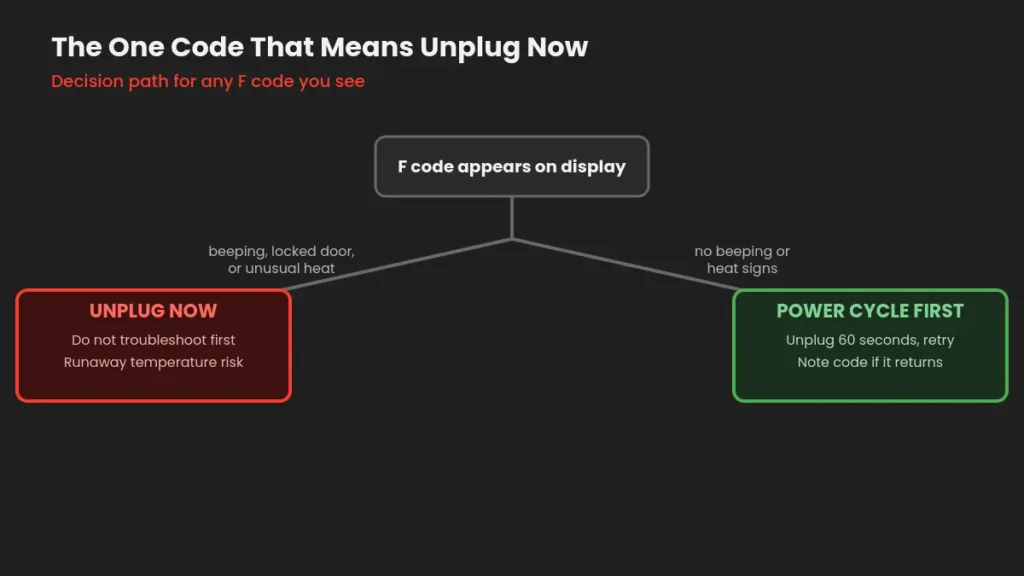
The One Category You Should Never Ignore: Runaway Temperature
Across both GE and Whirlpool ovens, there is a specific category of fault code tied to the oven detecting or risking a runaway temperature condition, meaning the oven has heated, or the board believes it may heat, well beyond the safe maximum regardless of what temperature was actually set. This is typically accompanied by continuous beeping, a locked door that won’t release, or the oven shutting off the heating element entirely as a protective measure.
If you see an error code combined with any of these signs, particularly if the oven feels unusually hot to the touch on the outside or you notice a burning smell that isn’t from food, unplug the oven at the wall immediately rather than trying to read the display or look anything up first. This is the one scenario in this entire guide where the correct first step is disconnecting power before doing anything else, including checking what the specific code number means.
Sensor Related Fault Codes
A large share of F codes on both brands trace back to the oven temperature sensor, a thin metal probe usually mounted on the back wall of the oven cavity that reports internal temperature to the control board continuously. When this sensor’s wiring opens, meaning the circuit breaks entirely, or shorts, meaning it reports a signal that doesn’t correspond to any real temperature, the board can no longer trust the readings and throws a fault rather than continuing to heat based on bad data.
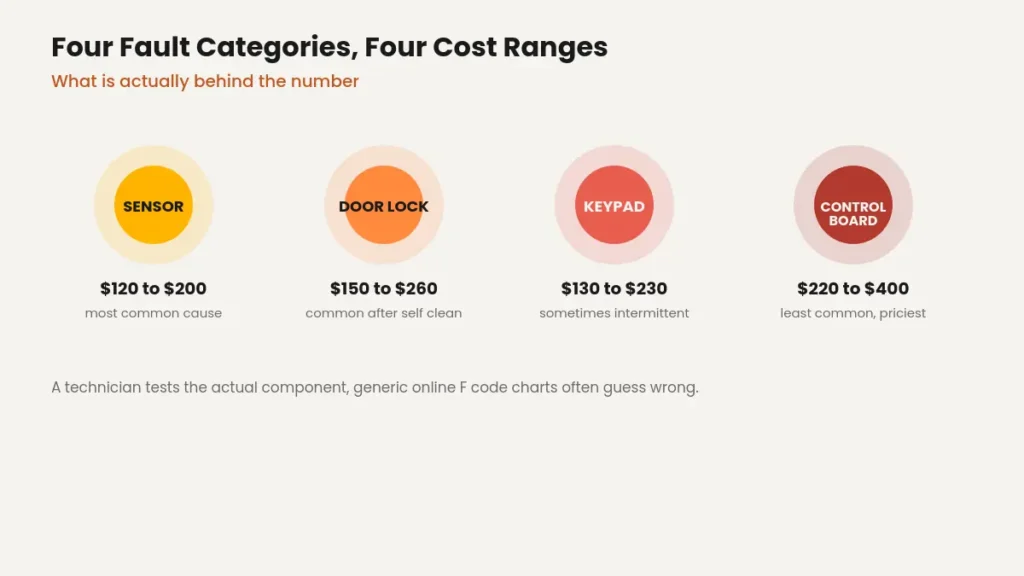
Sensor related faults are genuinely one of the more common reasons for an F code appearing, and thankfully one of the more affordable to resolve. Sensor replacement typically costs $120 to $200 including labor on either brand, and a technician can usually confirm this diagnosis quickly by testing the sensor’s resistance against the expected value for that specific model at room temperature.
Control Board Related Fault Codes
Some fault codes point not to a specific sensor or switch but to the control board itself, meaning its internal memory, processing, or communication with other components has failed in some way. These tend to be less common than sensor faults but more expensive to resolve, since the entire board typically needs replacement rather than a single small part.
Control board replacement generally runs $220 to $400 depending on the specific model and whether the board is readily available or needs to be special ordered. Before concluding the board itself is the problem, a good technician will usually rule out the cheaper, more common causes first, since a board that looks like it’s failing sometimes turns out to be correctly reacting to a genuinely failed sensor or switch elsewhere in the system.
Door Lock and Latch Fault Codes
Both GE and Whirlpool ovens use a locking mechanism on the door specifically for the self clean cycle, which runs the oven cavity at extremely high temperatures that would be dangerous to access mid cycle. A fault code tied to the door lock typically means the switch that confirms the door is locked, or unlocked, isn’t reporting the state the board expects, which can happen because the mechanism itself has worn out or because a switch has failed.
This category of fault shows up disproportionately often right after a self clean cycle, since that’s when the lock mechanism gets used and when the oven experiences its most extreme temperature swings. Door lock assembly replacement typically costs $150 to $260, and in some cases the oven will remain locked until this fault clears, which understandably causes some alarm the first time it happens to someone.
Keypad and Touch Panel Fault Codes
A membrane keypad or touch panel that’s developed a short, often from years of button presses or from moisture getting into the panel from nearby cooking, can register a phantom button press that never actually happened, or fail to register real ones. The control board interprets this as a fault since a key that reports as permanently pressed, or a panel that isn’t communicating properly, isn’t something it can safely ignore.
Keypad or touch panel replacement generally runs $130 to $230. This category of fault is sometimes intermittent before becoming constant, so a keypad that occasionally seems unresponsive or registers presses you didn’t make is worth mentioning specifically if you end up calling for service, since it points a technician toward this cause before they even open the panel.
Why GE and Whirlpool Codes Don’t Always Match
This is worth being direct about, since it’s the source of a lot of confusion when people search for what their specific code means. GE and Whirlpool, along with their related brands under the same parent companies, use their own internal numbering schemes for fault codes, and those numbers are not standardized across the industry. An F3 on a GE oven and an F3 on a Whirlpool oven do not necessarily indicate the same underlying problem, and even within one brand, numbering can shift somewhat between different model generations and years.
This is exactly why generic F code charts circulating online, the kind that list F1 through F9 with a single universal meaning for each, should be treated with real caution. The only fully reliable source for what a specific code means on your exact oven is the use and care manual that came with that specific model, which is usually available as a free download from the manufacturer’s website using your model number, found on a sticker inside the door frame or on the back panel. A technician working on your specific model also has access to the correct reference for that exact unit, which is part of why a phone diagnosis based on a code number alone is always somewhat of an educated guess rather than a certainty.
Can You Clear an F Code Yourself
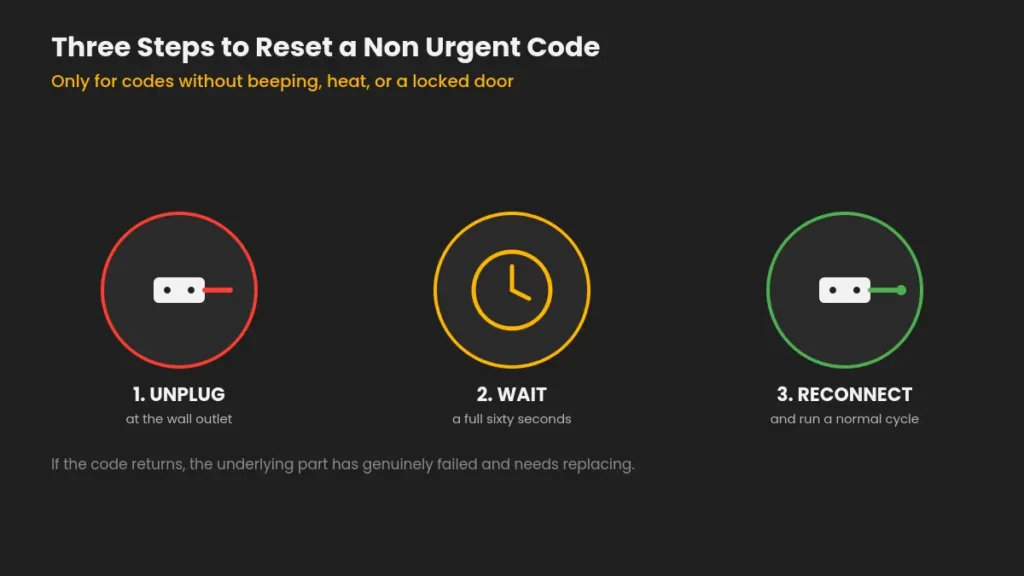
For non urgent fault codes, meaning anything other than the runaway temperature category covered earlier, it’s reasonable to try clearing the code yourself before assuming a part has failed. Unplugging the oven at the wall, or switching off the dedicated breaker if it’s hardwired, for a full sixty seconds allows the control board to fully reset and clear its fault memory. Plug it back in and run a normal bake cycle to see whether the code returns.
If the code clears and doesn’t come back, whatever triggered it was likely a temporary glitch rather than a genuine hardware failure, and no further action is needed. If the same code returns, especially if it returns quickly or immediately, that’s a strong sign the underlying component genuinely has failed and a reset alone won’t resolve it permanently.
What to Do the Moment You See an F Code
- Check whether the code is accompanied by continuous beeping, a locked door, or unusual heat, which signals the runaway temperature category
- If any of those signs are present, unplug the oven immediately rather than troubleshooting further
- For any other code, note the exact number and whether it appeared during a specific action, like starting self clean
- Try a full power cycle of at least sixty seconds before assuming a part has failed
- Look up your exact model number’s use and care manual rather than a generic online F code chart
Working through this order takes only a few minutes and either resolves the issue outright or gives a technician exactly the information they need to diagnose it quickly on the first visit.
Why This Happens More Often After Self Clean Cycles
Self clean cycles push an oven’s internal temperature far higher than any normal cooking setting, often exceeding 800 degrees Fahrenheit, and that extreme heat is genuinely stressful on the same sensors, wiring, and door lock components that operate fine under normal use. It’s a well known pattern among appliance technicians that a fault code appearing for the first time right after, or during, a self clean cycle points toward a component that was already marginal and finally gave out under that extra thermal stress, rather than a coincidence. We see this pattern regularly in Southfield and Clinton Township homes, especially around the holidays when ovens run more self clean cycles than usual before hosting. If your oven has run several self clean cycles and then developed a fault code shortly after, mentioning that timing to a technician helps narrow down the likely cause considerably. For a deeper look at temperature related oven issues specifically, our guide on why an oven isn’t heating to the correct temperature covers related causes in more detail.
Frequently Asked Questions About Oven F Code Errors
What does an F code mean on my oven?
An F code means the oven’s control board has detected a specific internal fault and stopped normal operation to flag it, rather than continuing to run with a malfunctioning component. The exact meaning of the number depends on the brand and model, so checking your specific use and care manual is the only fully reliable way to know precisely what triggered it.
Is it safe to keep using my oven if it shows an F code?
If the code is accompanied by continuous beeping, a door that won’t unlock, or the oven feeling unusually hot on the outside, unplug it immediately rather than continuing to use it, since this points to a runaway temperature condition. For other fault codes without those signs, it’s generally safe to attempt a power cycle reset before deciding whether the oven is safe to keep using.
Why does my oven keep showing the same F code after I reset it?
A code that returns after a full power cycle reset means the underlying component, most often a temperature sensor, control board, or door lock switch, has genuinely failed rather than experienced a temporary glitch. At that point the fault will keep reappearing until the actual part is diagnosed and replaced.
Do GE and Whirlpool use the same F code numbers for the same problems?
No, and this is a common source of confusion. Each brand uses its own internal numbering scheme, and the same number can mean different things between GE and Whirlpool, or even between different model years within the same brand. Generic online F code charts often don’t match a specific oven accurately for this reason.
How much does it cost to fix an oven showing an F code?
Costs vary by which component actually failed, typically $120 to $200 for a sensor, $130 to $260 for a keypad or door lock assembly, and $220 to $400 for a full control board replacement. A proper diagnosis identifies the specific failed part before any repair is quoted.
Get the Fault Diagnosed Correctly the First Time
An F code error tells you something specific has gone wrong, but translating that code number into an accurate diagnosis depends on knowing exactly which model you have and testing the actual component rather than guessing from a generic chart. A technician with access to the correct reference for your specific oven can identify the real cause and give you an accurate repair cost in a single visit.
Motor City Appliance Pros diagnoses oven and range fault codes across Michigan every week, with same day appointments and a 90 day warranty on every repair. If your dishwasher needs attention at the same time, our technicians can often take care of both during a single visit.