
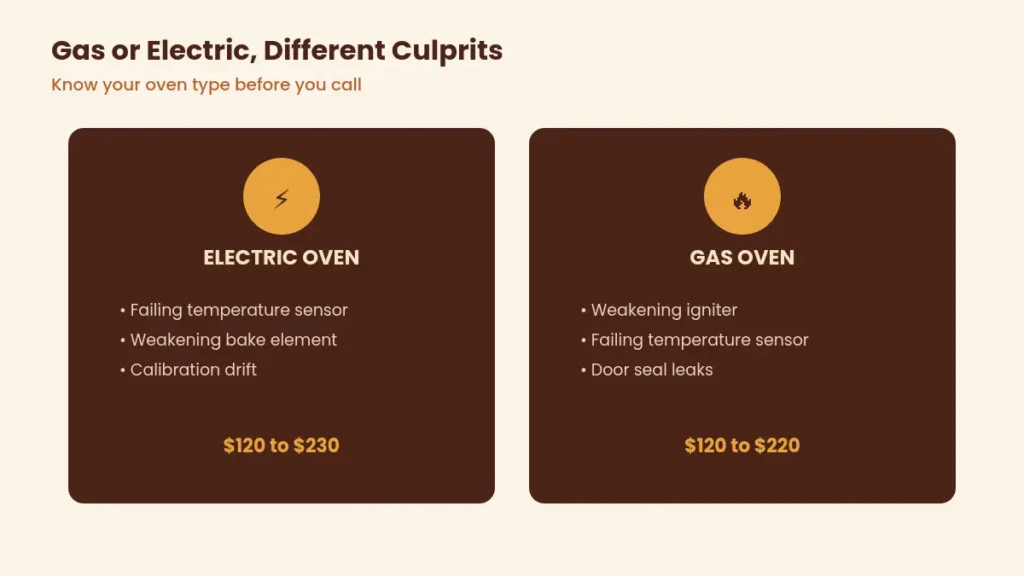
undercooked comes down to one uncomfortable fact: the number on the display is a request, not a guarantee. Ovens rely on a sensor to report the actual internal temperature back to the control board, and when that sensor drifts even twenty or thirty degrees off, everything you cook is affected while the display keeps showing the number you set with total confidence. A failing temperature sensor is the single most common cause of this complaint on electric ovens, while gas ovens more often point to a weakening igniter that can’t quite get the burner to full output. This guide walks through both, along with a few less common causes worth ruling out.
Most of these fixes are affordable and don’t require replacing the oven, even on units that are eight, ten, or more years old. The trick is figuring out which specific part is lying to the control board, since that’s really what’s happening here even though it doesn’t feel that way from the kitchen.
First, Confirm the Oven Is Actually Off Temperature
Before assuming a part has failed, it’s worth ruling out the simplest explanation: maybe the oven is fine and the real problem is how temperature is being judged. An inexpensive oven thermometer, the kind that hangs on a rack, is the only reliable way to know for sure. Set the oven to 350, let it fully preheat and then run for another fifteen minutes to stabilize, and check the thermometer reading. A swing of ten degrees either direction is completely normal and not worth chasing. Anything beyond twenty five to thirty degrees off, especially if it’s consistent across multiple temperature settings, points to a real problem worth addressing.
The Most Common Cause: A Failing Temperature Sensor
The temperature sensor, sometimes called an oven probe, is a slim metal rod usually mounted on the back wall of the oven cavity. It measures the air temperature and reports it continuously to the control board, which cycles the heating element or burner on and off to hold that target. When the sensor drifts, which happens gradually as the internal components age, it starts reporting a number that doesn’t match reality. An oven running consistently hot or cold across every temperature setting, rather than just at one specific point, is the classic signature of a sensor problem.
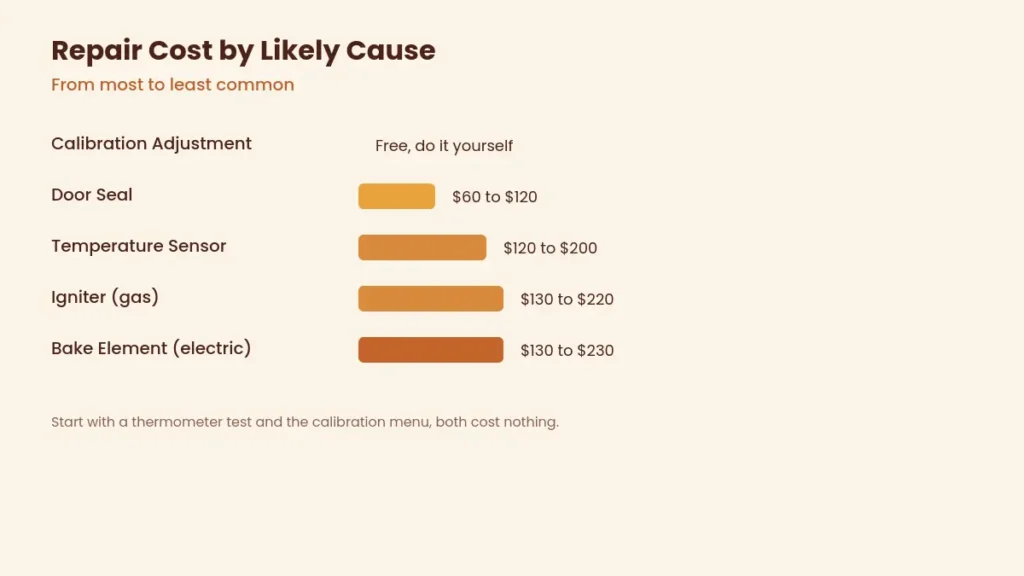
Sensor replacement is one of the more affordable oven repairs, typically $120 to $200 including labor. Technicians usually test it by comparing its resistance reading against a known chart for that specific value at room temperature, which takes only a few minutes and gives a definitive answer rather than a guess.
Gas Ovens: A Weak Igniter Changes Everything
On a gas oven, the igniter has to glow hot enough to trigger the safety valve that lets gas flow to the burner. As an igniter ages and weakens, it can still glow enough to light the burner, just more slowly or with less gas volume making it through before the valve fully opens. The practical result is an oven that takes noticeably longer to preheat and then struggles to maintain full temperature under load, especially with the door opened and closed repeatedly during cooking.
A weakening igniter often shows up as a bake that runs consistently cooler than expected rather than wildly inaccurate, since the oven is getting some heat, just not the full designed output. Igniter replacement runs $130 to $220, and it’s usually the first thing checked on a gas oven with this specific complaint, well before assuming the temperature sensor itself is at fault.
Electric Ovens: A Weakening Bake Element
The bake element, the coil visible at the bottom of most electric oven cavities, glows and produces heat as it wears. A partially failing element can still glow and produce some heat while falling well short of its rated output, which means the oven cycles on for longer stretches trying to reach a target it’s no longer physically capable of hitting quickly. In more advanced cases, sections of the coil visibly discolor or develop small blisters, sometimes with visible arcing, which is a clear sign it needs replacing regardless of temperature accuracy concerns.
Bake element replacement typically costs $130 to $230 depending on the model, and it’s one of the more straightforward repairs a technician handles, often completed within a single visit once the part is confirmed as the cause.
The Cheap Fix Worth Trying First: Calibration Offset
Here’s something a lot of homeowners never learn: most ovens built in the last fifteen or so years have a hidden calibration setting that lets you nudge the internal temperature reading up or down by a set number of degrees, without replacing anything. It’s usually buried a few menus deep, often accessed by holding two buttons simultaneously, and the exact combination varies by brand, so checking the manual or searching the model number is worth doing before assuming a part has failed.
If your oven thermometer test showed a consistent offset, say running fifteen degrees cool across every setting, adjusting the calibration by that same amount can resolve the issue completely at no cost. This won’t help if the sensor or igniter has failed outright, since those produce inconsistent rather than consistently offset readings, but it’s a five minute check worth doing before calling anyone.
Door Seal and Gasket Problems
The rubber or fiberglass gasket running around the oven door frame keeps hot air inside where it belongs. A seal that’s cracked, torn, or simply compressed flat after years of use lets heat escape steadily, which the oven tries to compensate for by running the element or burner longer and more often. This usually shows up as an oven that takes noticeably longer to preheat and seems to run hotter than the actual set temperature would suggest when you open the door, since it’s been overcompensating the whole time.
A visual check is usually enough here. Run a hand around the door perimeter while the oven is preheating, feeling for warm air escaping anywhere along the seal. Gasket replacement is inexpensive, generally $60 to $120, and one of the easier fixes on this entire list.
Convection Fan Issues Create Uneven Heat
For ovens with a convection setting, a failing fan motor doesn’t necessarily change the overall temperature reading, but it does create noticeably uneven results, one side of a sheet pan browning faster than the other, or a cake rising unevenly despite the display showing the correct number the entire time. This is a different complaint than a genuinely wrong temperature, but it gets described the same way often enough that it’s worth mentioning here. Fan motor replacement typically runs $150 to $250.
What You Can Check Yourself First
- Test with an independent oven thermometer rather than trusting the display alone
- Check whether the offset is consistent across multiple temperature settings
- Look up your model’s hidden calibration menu before assuming a part failed
- Feel around the door seal for escaping warm air while preheating
- Note whether results are wrong everywhere in the oven or just on one side
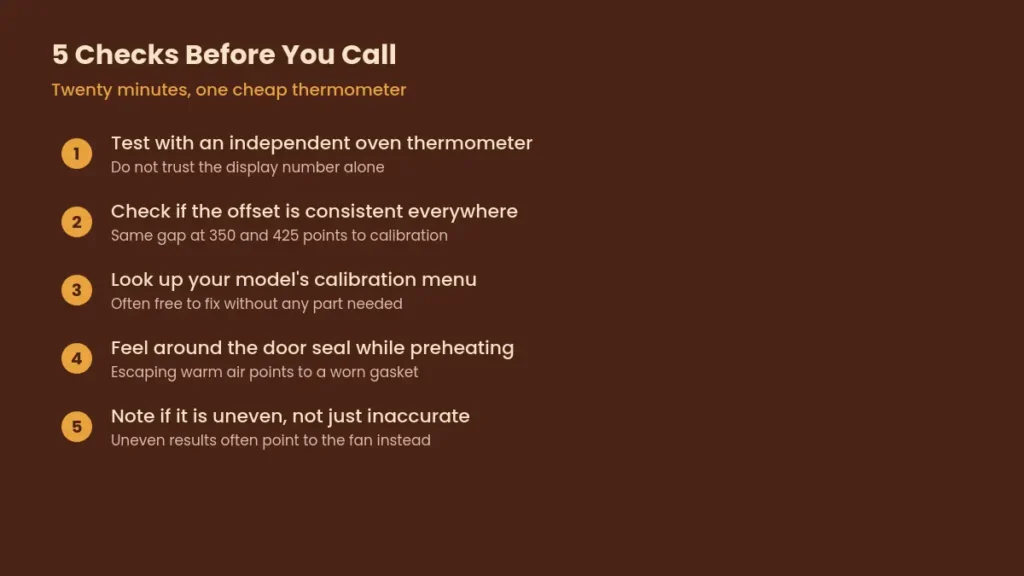
Five checks to try yourself before calling a technician
These checks take about twenty minutes combined and will usually point you toward either a free calibration fix or a specific part worth having a technician confirm and replace.
Why Getting This Right Matters More Than It Seems
A gap of even fifteen to twenty degrees sounds minor, but it meaningfully changes baking results, since recipes for bread, cakes, and pastries are calibrated tightly around specific temperatures for rise, texture, and browning. Roasting and general cooking tolerate the swing better, which is part of why this issue sometimes goes unnoticed for months until someone tries a recipe that actually depends on precision. We hear this complaint often from home bakers in Southgate and Romulus, usually after noticing bread or cookies just aren’t turning out the way they used to. If your baking results have quietly gotten worse over the past year without an obvious explanation, an inaccurate oven temperature is worth ruling out before blaming the recipe.
Frequently Asked Questions About an Oven Not Heating Correctly
How do I know if my oven temperature is actually wrong?
The only reliable way is an independent oven thermometer placed on a rack, checked after a full preheat plus about fifteen minutes to stabilize. A swing of ten degrees is normal, but anything beyond twenty five to thirty degrees, especially if consistent across multiple settings, points to a real issue.
Can I fix an inaccurate oven temperature myself?
If the offset is consistent across every setting, many ovens have a hidden calibration menu that lets you correct it yourself at no cost. If the readings are inconsistent or a part has visibly failed, like a discolored bake element, that repair is best left to a technician.
Why does my gas oven take so long to preheat?
A slow preheat on a gas oven often points to a weakening igniter that isn’t opening the gas valve fully or quickly. This typically gets worse gradually over months rather than happening suddenly, and igniter replacement usually resolves it completely.
Is it worth repairing an oven with a bad temperature sensor, or should I replace the whole unit?
Almost always worth repairing. A sensor replacement runs $120 to $200, which is a small fraction of the cost of a new oven and resolves the issue completely on an otherwise functional unit, regardless of the oven’s age.
Can a bad door seal really affect oven temperature that much?
Yes. A compromised seal lets heat escape continuously, forcing the oven to run its heating element or burner longer just to hold the set temperature, which shows up as slower preheating and less consistent results even though every other component is working correctly.
Get an Accurate Diagnosis Instead of Guessing
An oven that’s running hot, cold, or just inconsistently has a handful of likely causes, and testing with an independent thermometer is the right first step before assuming anything’s broken. When it turns out something has actually failed, a technician can identify exactly which part and give you a real repair cost before any work begins.
Motor City Appliance Pros repairs ovens and ranges across Michigan every week, with same day appointments and a 90 day warranty on every repair. If your dryer needs attention too, our technicians can often take care of both during a single visit.