
Your refrigerator is not cold enough but the freezer works fine because the two compartments share a single cooling system, and something is stopping the cold air made in the freezer from reaching the fresh food section below or beside it. The compressor and the evaporator are almost certainly working, but a fan, a damper, a clogged vent, or a thick layer of frost is interrupting the path between what gets cold and where your food actually lives.
This is one of the more confusing fridge problems to face, because the machine clearly isn’t completely dead. Your ice is fine, your frozen food is solid, and the compressor hums along as it always has. Yet you reach in for a jug of milk and it’s noticeably warmer than it should be, or you notice your leftovers have gone off faster than usual. Everything feels like it should be working, and most of it is.
At Motor City Appliance Pros, this specific symptom pattern, cold freezer plus warm fridge, is one of the clearest diagnostic clues a refrigerator can give us. It almost always points to one of four causes, and three of those four are straightforward repairs. This guide explains each one, how to narrow down which is yours, and what to do about it whether you’re fixing it yourself or calling someone in.
Why the Freezer and the Fridge Share One Cooling System
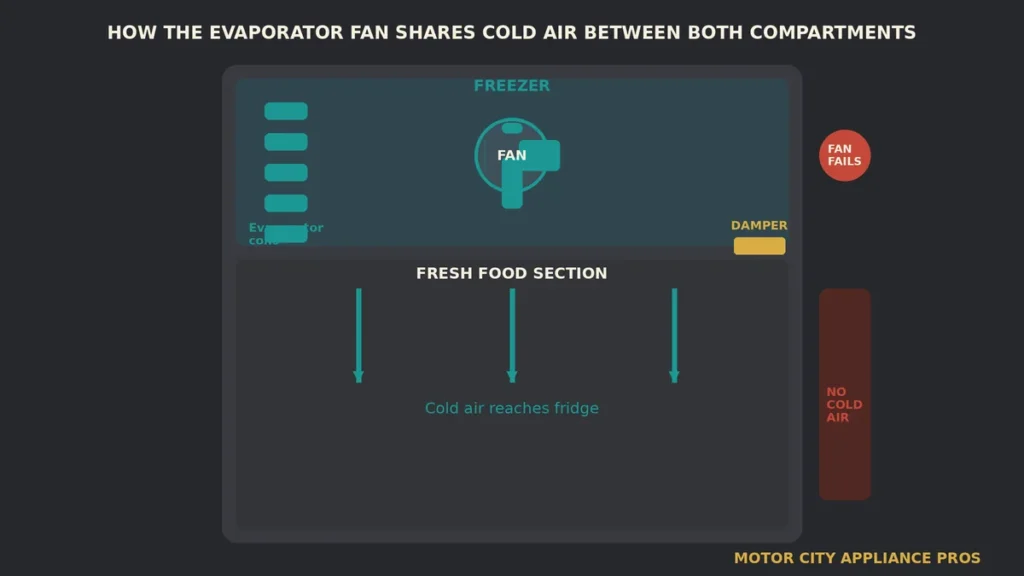
Most refrigerators, whether they’re a classic top freezer, a bottom freezer, or a French door model, make cold air in one place and distribute it to two separate compartments. The evaporator coils, which get cold by absorbing heat from the air blown over them, sit inside the freezer section. A small fan called the evaporator fan draws air across those coils and pushes it through vents into both the freezer and the fresh food section. A small component called the damper, or air diffuser, controls how much of that cold air flows toward the fridge and how much stays in the freezer.
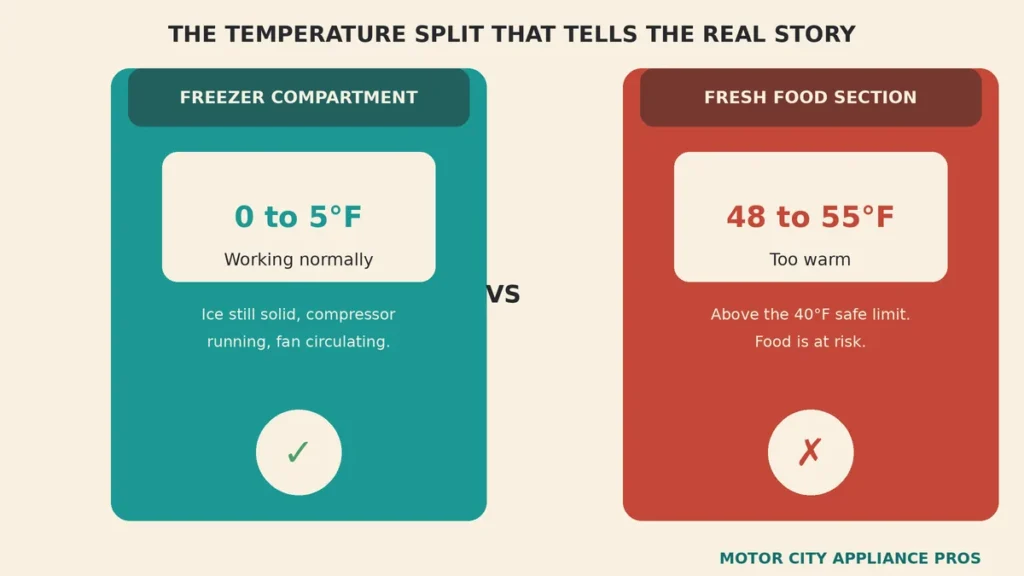
When everything works, cold air cycles through both sections continuously and both stay at their target temperatures, around 0 to 5 degrees Fahrenheit in the freezer and 35 to 40 degrees in the fridge. When the freezer is cold but the fridge is warm, the cold air is being made but it isn’t arriving in the fridge. That narrows the possible causes considerably.
The Evaporator Fan: The Most Common Cause
The evaporator fan is a small motor with a blade, sitting right next to the evaporator coils in the freezer section, usually behind a back panel. Its entire job is to push cold air through the duct system into both compartments. When it fails or runs at reduced speed, the freezer gets cold because it’s right next to the coils, but the fridge gets little to no airflow and warms up steadily.
There are a few ways to check whether the fan is the problem. Open the fridge door and listen: you should be able to hear the faint hum of the fan running inside the freezer when the compressor is on. If you hear no fan noise, or if the noise is louder and rougher than usual, a grinding or buzzing instead of a smooth hum, the fan motor is likely failing or has failed. Some fridges stop the fan when the door is open, so you may need to press and hold the door switch manually while listening.
Another quick check: put your hand in front of the vents inside the fridge. You should feel a gentle flow of cool air coming through. No airflow at all, or barely any movement, is a strong sign the fan isn’t doing its job. A failed evaporator fan motor is a relatively straightforward replacement job once you access the panel, and it’s one of the most common parts our technicians carry on service calls for this exact symptom.
The Air Damper: Small Part, Big Effect
The air damper sits at the opening where cold air passes from the freezer section into the fridge. It’s usually a small plastic flap or door, controlled either by a thermostat or a small motor, and its job is to open and close to regulate the amount of cold air flowing into the fresh food section. When it gets stuck in the closed position, the fridge warms up even though the fan is running perfectly and the evaporator is making cold air as usual.
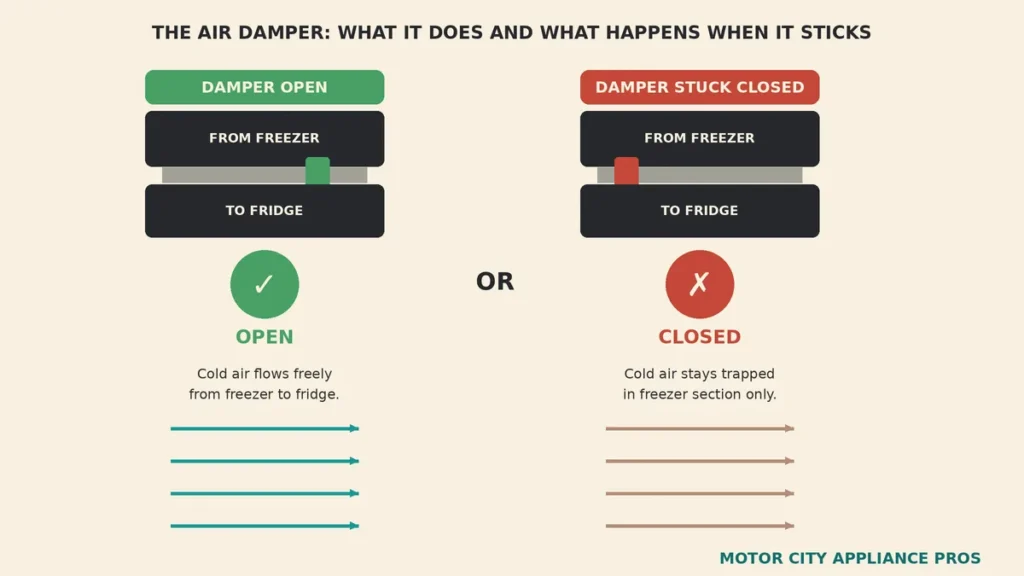
A stuck damper is particularly common after a power outage, a temperature swing, or on older refrigerators where the plastic has become brittle and warped. Ice can also form around the damper mechanism and freeze it shut, especially if the fridge has been running in a humid environment. You can usually find the damper at the top back of the fresh food compartment, sometimes behind a small plastic housing. If you can see or feel the flap and it’s visibly stuck or iced over, that’s your answer.
Defrosting the fridge completely will clear ice around the damper and often resolves the problem temporarily. If the damper itself is cracked, warped, or the motor controlling it has failed, replacing the damper assembly is the permanent fix. It’s a model specific part, and on newer refrigerators with electronic damper controls it requires a bit more diagnosis to confirm whether it’s the damper itself or the board signal telling it to open.
Frost Buildup on the Evaporator Coils
Every refrigerator has a defrost cycle that runs periodically, usually a few times a day, to melt any frost that’s accumulated on the evaporator coils. This prevents a thick layer of ice from building up and blocking the airflow through those coils. When the defrost system fails, whether it’s the defrost heater, the defrost thermostat, or the defrost timer or control board, frost keeps building up unchecked. Eventually the coils become encased in ice and air simply can’t pass through them into the fan or the vents.
The clue that points to this cause rather than a fan or damper issue is timing. Frost buildup tends to develop gradually, so you’ll often notice the fridge getting progressively warmer over a period of days or weeks before it becomes seriously warm. You might also notice the freezer itself getting slightly less cold than usual once the buildup is severe, because even the freezer compartment needs airflow across those coils to function well. Opening the back panel of the freezer, if you can reach it, and finding it caked in a thick solid block of ice rather than a thin normal frost layer, confirms this diagnosis.
A temporary fix is to defrost the fridge manually: unplug it, leave the doors open, and let everything melt over several hours. If the fridge cools properly for a few days and then gradually warms up again, the defrost system is definitely at fault and will need a proper repair rather than repeated manual defrosts.
Blocked or Clogged Air Vents Inside the Fridge
This cause is the simplest to check and fix, and it’s the one most likely to be a self inflicted problem. The vents that deliver cold air into the fresh food compartment are usually located along the back wall of the fridge, sometimes near the top, sometimes in multiple spots. If food is pushed directly up against those vents, or if the fridge is so packed that air can’t circulate around the shelves, the cold air gets blocked before it reaches the rest of the compartment.
This one shows up more in certain patterns. You might find the back of the fridge is cold while the front and door shelves are noticeably warmer. Or you might find one shelf level is cold while the ones above and below are warm. A quick reorganization, pulling food away from the back wall vents and leaving a bit of breathing room on each shelf, often produces a noticeable improvement within a few hours. If the fridge improves after this and stays improved, the problem was simply airflow restriction rather than a component failure.
A Few Other Causes Worth Ruling Out
A Door Seal That Isn’t Holding
A torn or stiff door gasket on the fridge section lets warm air in continuously, and the fridge has to fight that incoming heat while the freezer, with a tighter or undamaged seal, stays cold. Run your hand around the fridge door seal with the door closed and feel for any spots where air is escaping. The dollar bill test works here too: close the door on a bill and try to pull it out. Easy movement means poor contact at that spot.
A Refrigerant Leak
Less common with this specific symptom, but worth mentioning. A refrigerant leak tends to affect both compartments over time, but early in a leak the freezer may still get cold while the fridge section struggles. If you’ve ruled out the fan, damper, frost buildup, and door seal and the fridge still can’t hold temperature, a refrigerant issue or a partially failing compressor is worth having a technician assess. This one requires professional tools to diagnose and repair.
Condenser Coils Badly Clogged
Dirty condenser coils usually cause both compartments to run warm, but in early stages the freezer, being colder to begin with, can maintain temperature a little longer before the fridge section starts struggling. Pull the fridge out, look at the coils underneath or in the back, and vacuum any heavy dust or pet hair buildup. It takes five minutes and sometimes makes a real difference on its own.
How Michigan Homes Make This Problem More Likely
Michigan’s climate adds a couple of factors that raise the chances of this particular symptom showing up more often than it might in a drier or milder state. High summer humidity means more moisture enters the fridge every time the door opens, and that moisture is what eventually becomes frost on the evaporator coils. A defrost system that’s borderline, not fully failed but not fully keeping up either, can handle a dry December but lose the battle in a humid August.
Older housing stock in Detroit and the surrounding suburbs also matters. Homes from the mid century era often have kitchens that were designed around smaller refrigerators, and when a newer, larger French door model gets installed in that same space, it sometimes ends up with less clearance than it needs behind and on the sides. Restricted clearance raises the ambient temperature around the condenser, which forces the whole cooling system to work harder, and the fresh food section, already at the far end of the airflow distribution chain, is the first to fall below target.
If your fridge struggles every summer and recovers in cooler months, both of those factors are likely at play, and addressing the condenser clearance and checking the defrost system together is a more durable fix than treating them separately.
What to Check Before Calling a Technician
You can rule out a few causes yourself without opening anything up. First, check that the temperature control for the fridge section is set correctly and hasn’t been accidentally bumped. Second, pull everything away from the back wall vents and give the fridge a few hours to see if airflow improves. Third, inspect the door seal around the full perimeter of the fridge door. Fourth, listen for fan noise inside the freezer with the door closed and the door switch pressed in manually.
If the fridge has been progressively getting warmer over days or weeks, defrost it manually by unplugging it for several hours, mop up the water, and plug it back in. Monitor it for the next few days. If it cools back to normal and holds that temperature, you’ve confirmed a defrost system failure and can schedule a repair with a specific target in mind. If it never recovers after defrosting, the problem is more likely the fan or damper rather than frost buildup.
When It Is Time to Call a Technician
Replacing an evaporator fan motor, a damper assembly, a defrost heater, or a defrost thermostat all require removing internal panels and working with wiring, and they need parts specific to your refrigerator’s make and model. If your checks point clearly to one of those components, or if you’ve done a manual defrost and the fridge is still warm, that’s the right moment to call someone rather than guess further.
Our refrigerator repair technicians diagnose this exact symptom pattern every week, carrying the common fan motors, dampers, and defrost parts for the most popular brands. We offer same day service and a 90 day warranty on all repairs. A related problem that often comes in the same visit is a freezer that’s running fine but making unusual noise, and if that’s happening alongside a warm fridge, it can actually help narrow the diagnosis. If you’d like to read more about what that might mean, our already published article on why a refrigerator is running but not cooling covers the compressor and sealed system side of these issues in more depth.
The fresh food section being warm while the freezer is cold is one of those problems that feels mysterious but isn’t. The cold air is there. Something small is stopping it from getting where it needs to go, and once we find that thing, the fix is usually quick.
Refrigerator Repair Across Michigan
Motor City Appliance Pros serves homes across Michigan, and our technicians bring the evaporator fan motors, damper assemblies, and defrost components that solve most of these calls in a single visit. In the northern metro area, our Rochester Hills appliance repair team handles same day calls throughout Oakland County. Further south, our Taylor appliance repair technicians cover the downriver communities on the same terms.
Whatever brand you have and wherever you are, you get a technician who traces the airflow from the evaporator to the fridge vents, confirms the damper position, checks the defrost cycle, and gives you a clear explanation and a firm price before starting the repair. A cold freezer and a warm fridge is one of the most fixable refrigerator problems there is, as long as you catch it before the food inside gives out.
So, why is your refrigerator not cold enough but the freezer works fine? Because something small is blocking the path that cold air takes from the evaporator to the fresh food section. Check the fan, the damper, the vents, and the door seal in that order, and you will almost always find the answer before the technician even needs to open a panel.
Frequently Asked Questions
Why would only the fridge get warm if the compressor is still running?
Because the compressor and the evaporator only make cold air in one place, the freezer section. Getting that cold air to the fridge depends on a working fan, an open damper, and clear vents. Any one of those failing leaves the compressor running normally while the fridge section gets no benefit from it.
Can I fix a stuck damper myself?
If the damper is stuck due to ice, unplugging the fridge and letting it defrost fully will usually free it. If the damper flap itself is broken or warped, or if the small motor driving it has failed, replacing the damper assembly is a parts and wiring job. On many models it is accessible from inside the fridge without specialized tools, but you need the correct replacement part for your model number.
How do I know if my evaporator coils are frosted over?
Remove the back panel inside the freezer compartment, usually held by a few screws. If the coils behind it are encased in a thick solid block of ice rather than a thin even frost coating, the defrost system has failed and the coils are blocked. Unplugging the fridge and letting that ice melt is the first step, but the defrost heater or thermostat will need replacing to prevent it from happening again.
Could a bad door seal on the fridge cause this exact symptom?
Yes. A door seal that is cracked, stiff, or not gripping allows warm air to enter the fresh food section continuously. The compressor and fan keep working normally, so the freezer holds its temperature, but the fridge has to fight a constant warm air leak that it can’t overcome. Replacing a door gasket is one of the lower cost repairs and worth checking early.
My fridge gradually got warmer over two weeks. What does that suggest?
A gradual decline over days or weeks almost always points to frost buildup on the evaporator coils. The ice grows slowly until it blocks enough airflow to affect the fridge temperature, which is why it feels like a gradual problem rather than a sudden one. A manual defrost that temporarily restores cooling confirms this. The permanent fix is replacing whichever defrost component has failed.
Is it safe to eat food from a fridge that’s been running at 50 degrees?
Food that has been above 40 degrees Fahrenheit for more than two hours should be treated cautiously. Perishables like meat, dairy, cooked food, and anything with eggs should be discarded if you cannot confirm how long the fridge has been warm. When in doubt, throw it out. The cost of food poisoning far outweighs the cost of replacing groceries.