
A washer stuck on one cycle usually means the control board is waiting for a signal that never arrives. That missing signal is most often a locked door, a drained tub, a balanced load, or the right water level. In most homes the cause is one of nine things: an unbalanced load, too much detergent, a clogged drain, a faulty door or lid lock, a weak water supply, a worn water level switch, a failing drain pump, a motor or belt problem, or a control board fault. The first four are often fixable in minutes without tools.
This guide walks you through each cause in plain language, shows you how to match the stage your washer stops on to the likely problem, and explains when it is time to call a technician. Everything here applies to the washers we see every week across Metro Detroit, including Whirlpool, Maytag, Samsung, LG, GE, Kenmore, and Speed Queen models.
Try This First: The 5 Minute Washer Reset
Before you dig into causes, run a reset. Modern washers run on small computers, and those computers sometimes freeze after a power flicker, an interrupted cycle, or an unbalanced spin. A reset costs nothing and clears a surprising number of stuck cycles.
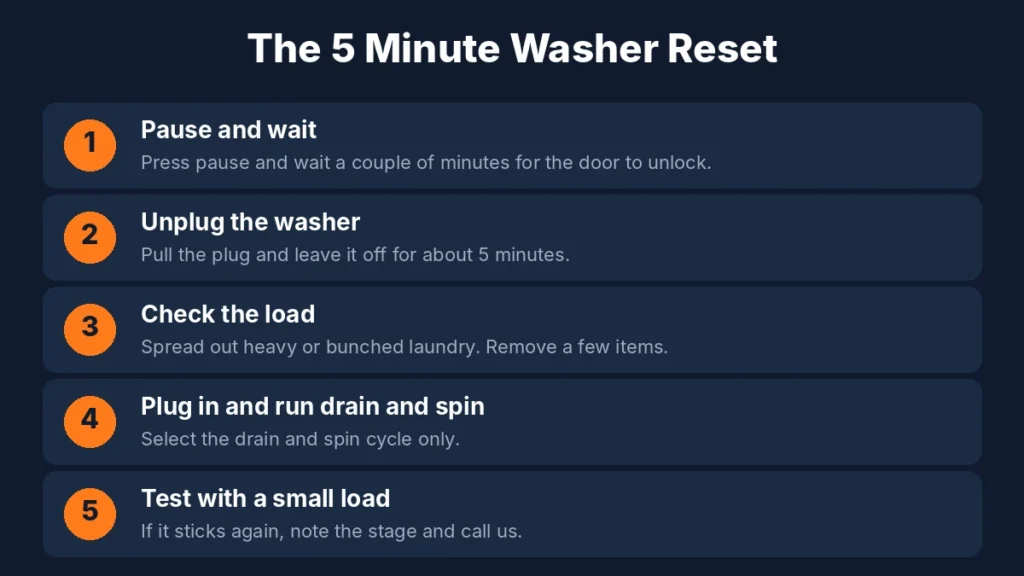
- Press pause or cancel, then wait a couple of minutes. Many washers keep the door locked briefly after stopping.
- Unplug the washer from the wall and leave it unplugged for about 5 minutes. If the plug is hard to reach, switch off the breaker instead.
- Open the door or lid and look at the load. If clothes are bunched on one side or twisted around the agitator, spread them out and remove a few heavy items.
- Plug the washer back in and run the drain and spin cycle alone.
- If it finishes, try a small test load. If it sticks again at the same stage, note which stage it was and use the sections below.
If water is sitting in the drum, do not keep restarting the machine. Standing water and electrical parts do not mix, and repeated restarts can strain the drain pump. Move to the drain section below first.
Which Cycle Is Your Washer Stuck On?
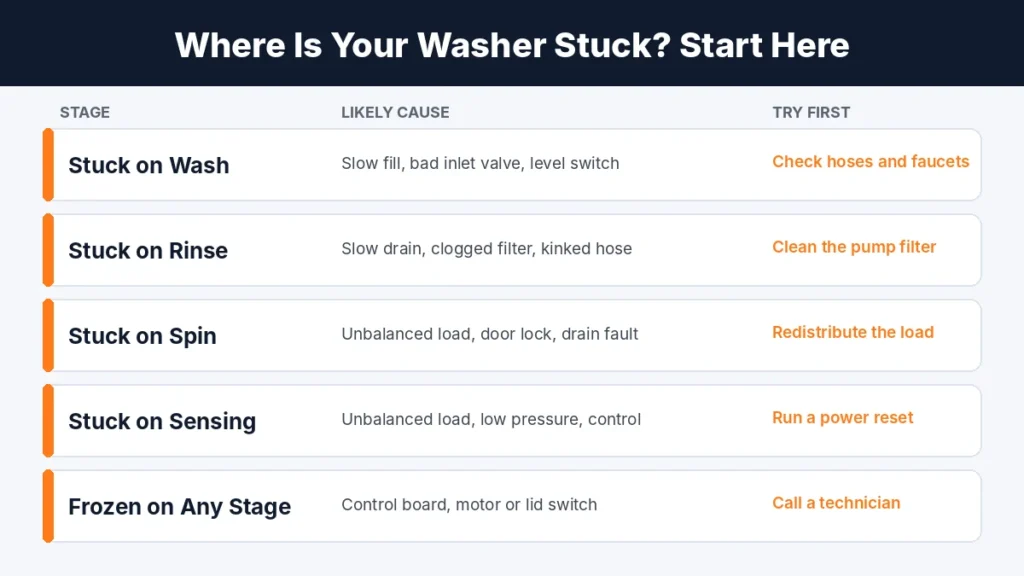
The stage where your washer stops is the best clue you have. Different parts control different stages, so matching the symptom to the stage narrows the search quickly.
Stuck on the Wash Stage
If the washer fills a little and then sits there, or keeps agitating without ever moving on, the machine usually does not believe the tub is full or does not sense the right water level. Common causes include weak water supply, a clogged inlet screen, or a worn level switch. Check that both faucets are fully open.
Stuck on the Rinse Stage
A washer that never leaves the rinse usually has trouble draining. The control board will not advance until the tub empties to the expected level. A blocked drain hose, a clogged pump filter, or a failing drain pump are the top suspects.
Stuck on the Spin Stage
A washer stuck on spin often has a load that is too heavy, too small, or lopsided. The machine tries to spin, senses an imbalance, stops, redistributes, and tries again. After several failed attempts it may sit there indefinitely.
Stuck on Sensing or Final Spin
Some washers, especially top load models from Whirlpool and Maytag, can hang on a sensing or estimating stage. Load imbalance, low water pressure, or a faulty level switch are the usual causes.
Frozen on Every Stage
If the display stays on one setting, the buttons do nothing, or the washer will not advance no matter what you do, the problem is likely electronic. A control board, a lid switch, or a motor control fault can all produce this symptom. That is the point where a diagnostic visit saves time.
Common Reasons a Washer Gets Stuck on One Cycle
1. An Unbalanced or Overloaded Load
This is the most common cause and the easiest to fix. Heavy items like towels, jeans, and bedding bunch on one side of the drum and throw it off balance. The washer detects the wobble through sensors, stops the spin, and tries to redistribute the clothes. If it cannot, it pauses or repeats the attempt. Washing one heavy item alone, like a single comforter, is a classic trigger.
The fix is simple. Open the washer, spread the laundry evenly, and mix heavy and light items together. Do not pack the drum to the top. Aim for a loose fill with room for clothes to move.
2. Too Much Detergent or the Wrong Detergent
Excess suds are a sneaky cause of stuck cycles. High efficiency washers use very little water, so regular detergent or too much of any detergent creates foam that the washer cannot rinse or drain. Many models pause until the suds clear.
Run a rinse and spin with no detergent. Use only the amount recommended for your load size and look for the HE label on the bottle. Using less detergent than the cap suggests often works better and keeps the machine cleaner.
3. A Clogged Drain Hose or Pump Filter
When water cannot leave the tub, the washer will not move on. Front load washers have a small pump filter near the bottom front, often behind a lower panel. Coins, hair ties, socks, and lint collect there and block the flow.
Unplug the washer first. Place a shallow pan and towels under the filter access, open the filter slowly, and let the water drain out before removing it. Clean out any debris, put the filter back, and run a drain and spin cycle. Also check that the drain hose behind the washer is not kinked.
4. A Faulty Door or Lid Lock
Washers will not run unless they confirm the door or lid is closed and locked. A worn latch, a loose striker, or a failing lid switch can make the washer think the door is open, even when it is shut. The result is a cycle that starts, pauses, and refuses to advance.
Check for anything stuck around the door seal or latch, such as a sock or a piece of lint. On a top load washer, press down on the lid while the cycle runs and see if it moves forward. If it does, the lid switch or its wiring needs replacement. Never force a locked door open while water is inside.
5. Low Water Pressure or a Blocked Inlet Valve
A washer needs a steady supply of water to reach its fill level. If the inlet screens are clogged with sediment or the water inlet valve is failing, the tub fills too slowly or not at all. The control board waits for the right level, and nothing happens. Hard water and mineral buildup, which are common in parts of Southeast Michigan, make this problem more likely over time.
Check that both faucets are fully open. Turn off the water, unplug the washer, and unscrew the hoses from the back to look at the small screens inside the inlet ports. If they are clogged with grit, rinse them clean. If the screens are clear and fill is still slow, the inlet valve may be weak.
6. A Worn Water Level Switch or Pressure Sensor
Most washers use a small pressure switch connected to the tub by a thin air hose. It tells the control board how much water is in the tub. If the hose gets pinched, clogged, or loose, or if the switch itself wears out, the washer gets wrong information. It may overfill, underfill, or never leave the fill and wash stages.
7. A Failing Drain Pump
If you cleaned the filter and the hose and the tub still holds water, the drain pump may be failing. Signs include a humming or grinding sound while the washer tries to drain, a loud rattle that was not there before, or no sound at all when it should be pumping. A weak pump drains slowly, which keeps the washer stuck in rinse. Replacing the pump is a common repair and one we complete on many visits.
8. A Motor, Belt, or Coupling Problem
The motor turns the drum or agitator, and on many models a belt or coupler connects the motor to the drive. When a belt slips or a coupler breaks, the washer fills, runs, and sounds normal at first, but the drum barely turns or never reaches spin speed. Some machines keep trying and never complete the cycle. A burning rubber smell, a squeal, or clothes that come out soaking wet often go with this problem.
9. A Control Board or Timer Failure
The control board tells every other part when to run. When it fails, the symptoms can look random: cycles that skip steps, buttons that stop working, or a display stuck on one setting. Because this part is expensive, a correct diagnosis matters. Many problems that look like a bad board are really a lid switch or sensor, which is why we test before we replace.
Brand Notes for Whirlpool, Maytag, Samsung, and LG
Whirlpool and Maytag top loaders often stall on the sensing stage when a load is lopsided or the water level sensor is off. Samsung and LG front loaders tend to show a code when they get stuck. On many LG washers, a UE code points to an unbalanced load, an OE code points to a drain problem, and a dE code points to the door. On many Samsung washers, a UB code signals an unbalanced load and a 5C or SC code signals a drain problem. Codes vary by model and year, so check your manual before acting on any code.
Why Michigan Homes Run Into This More Often
A few local factors make stuck cycles more common around Detroit. Hard water leaves mineral deposits that clog inlet screens and slow fill. Older homes often have laundry set up in basements with long drain runs or aging standpipes, and a drain that is partly blocked is enough to stall a rinse. Power flickers during storms can also confuse electronic controls and freeze a cycle mid wash. If your washer acts up after a storm, try the reset first.
What You Can Safely Check Yourself
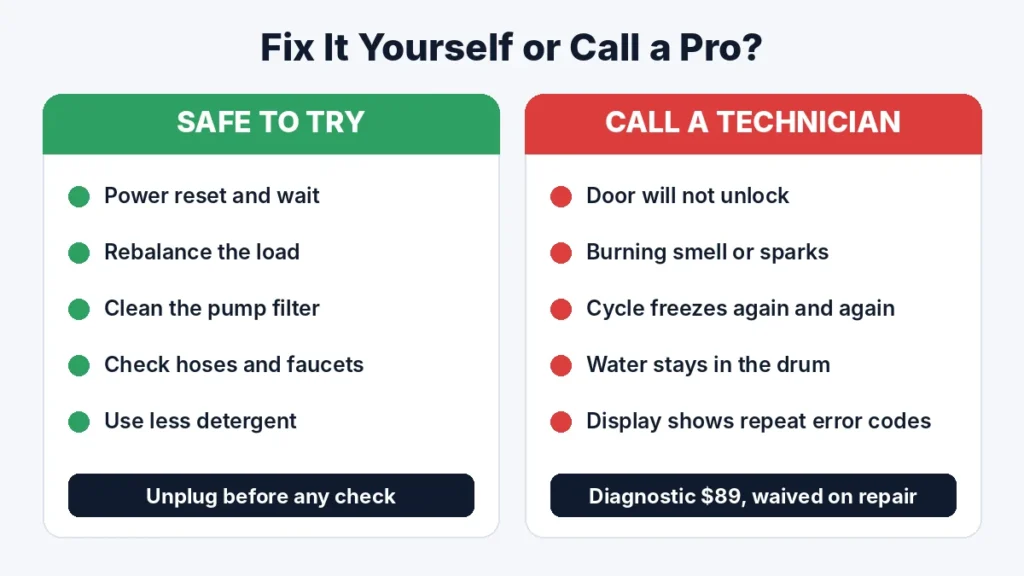
- Load balance. Spread the laundry evenly and avoid washing one heavy item alone.
- Detergent amount. Use the recommended HE amount and run a rinse if suds are visible.
- Faucets and hoses. Confirm both are fully open and that the hoses are not kinked.
- Pump filter. Clean it on front load models, using a pan and towels.
- Drain hose. Make sure it is not crushed behind the machine and sits properly in the standpipe.
- Door or lid. Look for debris in the latch or seal.
What You Should Never Do
- Never open the washer panels or touch wiring while it is plugged in.
- Never force a locked door open while the drum has water in it.
- Never keep restarting a washer that is full of standing water.
- Never bypass the lid switch or the door lock. It is a safety device.
- Never ignore a burning smell or smoke. Unplug the washer and call for service.
When to Call a Professional Washer Repair Technician
Call for service if the reset does not work, the same stage fails again, the door will not unlock, the drum holds water after you cleaned the filter, or you smell something burning. A technician can test the lid switch, level switch, inlet valve, drain pump, motor, and control board with the right tools and tell you which part is actually at fault.
Motor City Appliance Pros provides same day washing machine repair in Detroit and serves nearby suburbs including Warren and Taylor. If your dryer has also started acting up, our dryer repair service covers that too, and you can book either one from the Motor City Appliance Pros homepage. Our trucks carry thousands of common parts, so many washer repairs finish in a single visit, and every repair carries a 90 day warranty.
How Much Does It Cost to Fix a Washer Stuck on One Cycle?
The cost depends on the part. A load balance or a clogged filter costs nothing if you handle it yourself. Most professional washer repairs in Metro Detroit land between $140 and $420 all in, depending on the part. Our diagnostic visit is $89, and it is waived when you approve the repair. You receive a firm written price before any work starts. Simple parts like a drain pump, inlet valve, or lid switch sit on the lower side of that range, while a control board or motor sits higher.
If your washer is more than 10 to 12 years old and needs a major part, compare the repair cost with the price of a new machine. If the repair is less than about half the price of a comparable new washer, repair usually makes sense.
How to Stop Your Washer From Getting Stuck Again
- Load the drum evenly and avoid washing one heavy item alone.
- Use the right amount of HE detergent and skip fabric softener overload.
- Clean the pump filter every few months on a front load washer.
- Wipe the door seal and leave the door ajar after use to cut mildew.
- Run a washer cleaning cycle monthly to clear detergent and mineral buildup.
Frequently Asked Questions
Why is my washer stuck on one cycle and not moving forward?
The control board is waiting for a signal it is not getting. Common causes are an unbalanced load, too much detergent, a clogged drain, a faulty door or lid lock, low water supply, or a bad level switch.
How do I reset a washing machine that is stuck?
Pause the cycle, wait a couple of minutes, unplug the washer for about 5 minutes, check the load, plug it back in, and run a drain and spin cycle.
Why is my washer stuck on the rinse cycle?
A drain problem is the most likely reason. Check the pump filter and the drain hose, and look for suds from too much detergent.
Why is my washer stuck on the spin cycle?
The load is usually unbalanced, or the door lock or drain system is not giving the right signal. Redistribute the clothes and run drain and spin.
Can too much detergent make a washer stop?
Yes. Excess suds can slow drain and rinse, and some machines wait until the foam clears before continuing.
Can a power outage cause a washer to freeze on a cycle?
Yes. Power flickers and surges can scramble the control board. A reset usually clears a temporary glitch.
Is a stuck washer cycle worth repairing?
Most of the time, yes. Many causes are inexpensive parts, and repair costs far less than a new machine unless the washer is very old.
Final Takeaway
A washer stuck on one cycle is rarely a lost cause. Start with a reset, check the load, and note the stage where it stops. That one detail points to the likely cause, whether it is a drain clog, an unbalanced load, a door lock, or a worn sensor. If the quick fixes do not work, or the washer shows signs of a deeper problem, a trained technician can find the real fault and get your laundry moving again.