
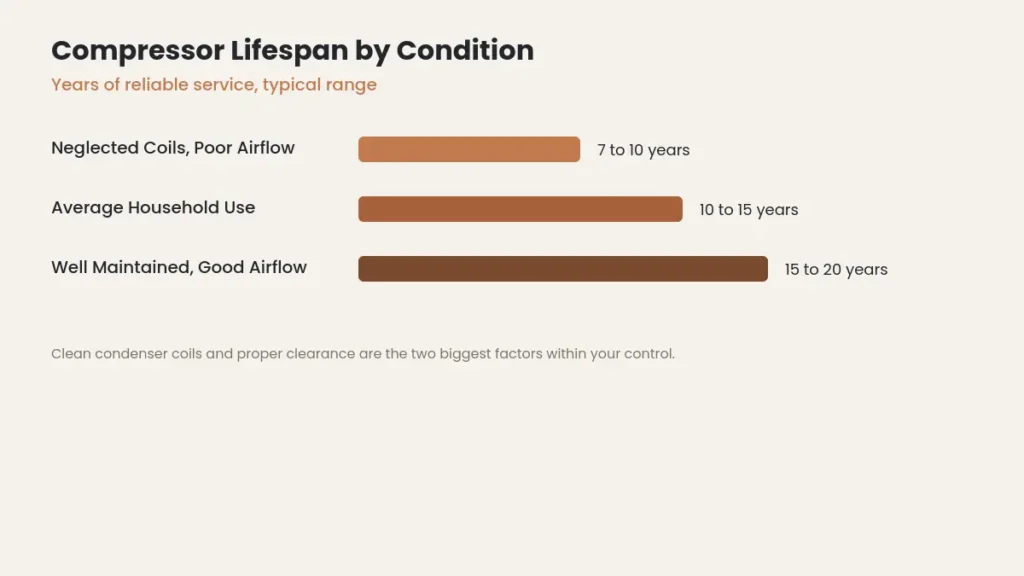
How long a refrigerator compressor should last comes down to a fairly consistent answer across the industry: most well built compressors run reliably for 10 to 15 years, and it’s not unusual to see one still going strong at 18 or 20 years in a home that’s treated it well. That said, the number on paper and the number you actually get depend heavily on things most homeowners never think about, condenser coil cleanliness, ventilation around the unit, power quality, and how hard the compressor has had to work over its lifetime. This guide walks through what actually determines that lifespan, the warning signs worth paying attention to, and why a surprising number of suspected compressor failures turn out to be something else entirely.
If your fridge is getting up there in age and you’re wondering whether the compressor is on borrowed time, or if you’re just trying to get more life out of a newer one, understanding what actually wears a compressor down is far more useful than just knowing an average number.
What a Compressor Actually Does, and Why It Matters So Much
The compressor is the heart of a refrigerator’s cooling system, and it’s genuinely the one component that everything else depends on. It pressurizes refrigerant gas and pushes it through the coils, where it releases heat outside the fridge and absorbs heat from inside, which is the entire mechanism behind keeping your food cold. Unlike a lot of appliance parts that can be swapped out affordably when they wear down, a compressor sits inside a sealed system that’s genuinely difficult and expensive to service, which is exactly why its lifespan matters so much more than, say, a door switch or a light bulb.
This is also why a compressor failure feels so much more serious than most other refrigerator repairs. It’s not just one part failing, it’s the part everything else was built around.
Average Compressor Lifespan by the Numbers
Most manufacturer estimates and independent repair data land in a similar range: 10 to 15 years of reliable operation under normal household conditions. Refrigerators built with rotary or reciprocating compressors, which cover the vast majority of residential units, tend to fall on the lower end of that range if conditions are tough, and comfortably exceed it if conditions are good. Higher end models, particularly those with inverter compressors that adjust speed rather than simply cycling on and off, often report somewhat longer expected lifespans, sometimes pushing past 15 years, since they run at lower average loads rather than constantly starting and stopping at full power.
It’s worth noting that the rest of a typical refrigerator, the shelving, door seals, ice maker, control boards, generally wears out or becomes outdated before the compressor does under normal circumstances. When a compressor does fail early, well before that 10 year mark, it’s almost always traceable to one of the stress factors covered next rather than simple bad luck or a manufacturing defect.
What Actually Shortens a Compressor’s Life
A handful of conditions consistently show up in compressors that fail early, and nearly all of them come down to the compressor working harder than it should have to.
Dirty condenser coils are the single most common and most preventable cause. These coils, usually located behind or underneath the fridge, need airflow to release the heat the compressor is pumping out. When they’re coated in dust, pet hair, and kitchen grease, which happens gradually and invisibly over years, the compressor has to run longer and hotter to compensate, and that sustained extra heat is exactly what shortens its lifespan.
Poor ventilation around the unit creates a similar problem even with clean coils. Refrigerators pushed flush against a wall, or built into a tight cabinet enclosure without proper clearance, trap the heat the compressor generates right where it’s working, forcing it to run in a warmer environment than it was designed for on every single cycle.
Voltage fluctuations and power surges put a different kind of stress on a compressor, specifically on the motor windings and the start components, rather than on heat management. Homes with older electrical systems, or areas prone to storm related power blips, put compressors through repeated small shocks that add up over years, even when no single event seems serious enough to notice at the time.
An overworked compressor from other causes, a door seal that’s not sealing properly, a fridge packed so full that air can’t circulate internally, or a unit set colder than actually necessary, all force the compressor to run more often and for longer stretches than its design intended, aging it faster than the calendar alone would suggest.
Signs Your Compressor Is Actually Failing
A genuinely failing compressor tends to show a fairly recognizable pattern rather than failing silently overnight. Listen for a change in sound first, a compressor nearing the end often develops a noticeably louder hum, a clicking that repeats every few minutes, or a buzzing sound as it struggles to start. A fridge that used to cycle on and off periodically but now seems to run almost constantly is trying to compensate for reduced compressor efficiency. Warmth around the back or bottom panel beyond what feels normal, combined with a fridge interior that’s not quite as cold as it used to be, rounds out the classic picture.
A noticeably higher electric bill without any other explanation is worth mentioning too, since a struggling compressor draws more power trying to accomplish the same cooling job. None of these signs alone confirms a compressor problem definitively, which is exactly why the next section matters so much.
Compressor Failure or Something Cheaper: The Common Mix Up
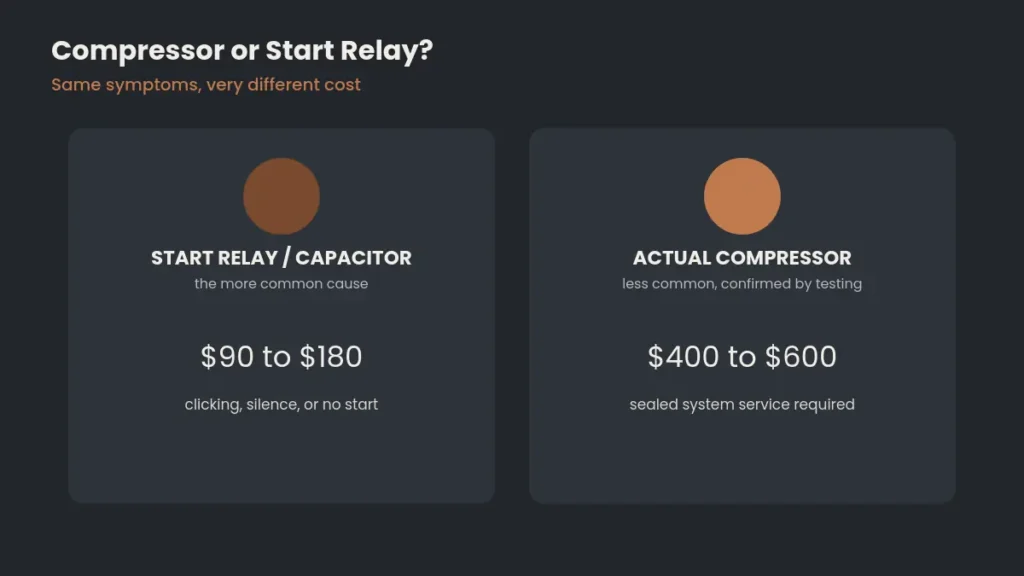
Here’s something worth knowing before assuming the worst. A genuinely dead compressor is actually less common than people expect, because a separate, much cheaper component often fails first and produces nearly identical symptoms. The start relay and the start capacitor are small parts that help the compressor motor kick on, and when either fails, the compressor can appear completely dead, no cooling, a clicking sound, sometimes silence, while the compressor itself is still perfectly fine mechanically.
A technician can typically tell the difference within a few minutes using a simple test, and the cost difference is significant. Start relay or capacitor replacement usually runs $90 to $180 including labor, compared to $400 to $600 or more for an actual compressor replacement, which involves recovering refrigerant, cutting into the sealed system, and recharging it afterward. This is exactly why getting a proper diagnosis before assuming the worst matters so much, since what looks and sounds like a dying compressor is frequently a $100 fix rather than a $500 one.
Repair or Replace When It’s Actually the Compressor
If a technician confirms the compressor itself has failed, the repair versus replace decision gets more complicated than it does for most other appliance parts. Compressor replacement typically runs $400 to $600 including the labor intensive process of servicing the sealed refrigerant system, which on an older refrigerator can approach or exceed half the cost of a new comparable unit, tipping the math toward replacement under the standard 50 percent rule.
Age matters enormously here. A five or six year old refrigerator with a failed compressor is usually worth repairing, since the rest of the unit has plenty of useful life left and a repaired compressor should easily deliver another decade of service. A twelve or fourteen year old unit facing the same repair is a much closer call, and often tips toward replacement, especially when you factor in that a new refrigerator will run meaningfully more efficiently on your electric bill going forward.
How to Actually Extend Compressor Life
- Vacuum or brush the condenser coils twice a year, more often with pets in the house
- Leave several inches of clearance around and behind the unit for proper airflow
- Avoid overpacking the fridge, air needs room to circulate around stored food
- Let hot leftovers cool briefly before placing them inside rather than adding heat load directly
- Consider a surge protector if your home has older wiring or frequent power fluctuations
- Check door seals periodically, since a poor seal forces the compressor to work overtime
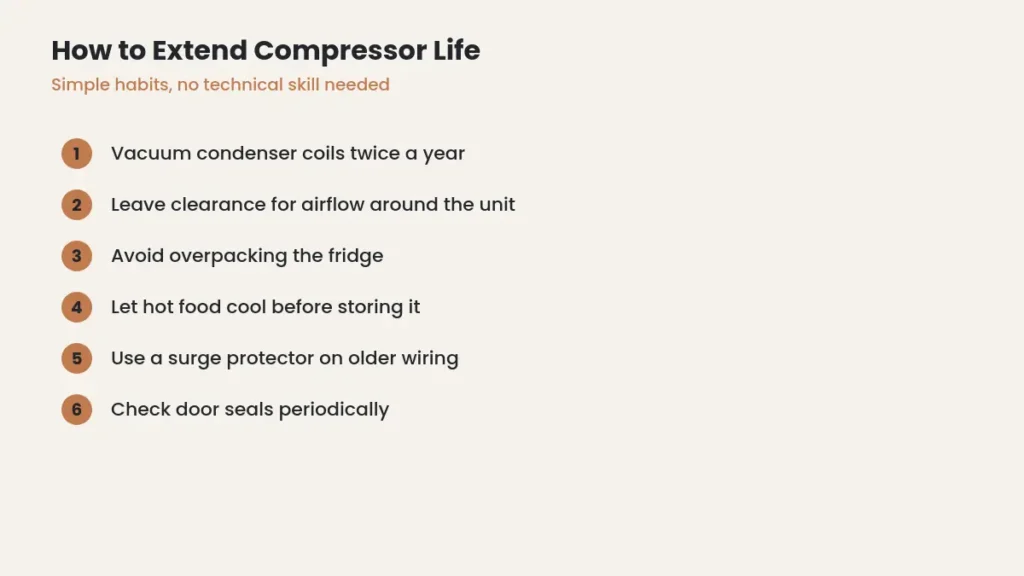
None of these habits require any technical skill, and together they’re the difference between a compressor that struggles at year nine and one that’s still running comfortably at year sixteen or beyond.
Why This Comes Up More in Michigan Homes
Refrigerators kept in an unheated garage, common across Michigan for a second fridge or a deep freezer setup, face a genuinely harder environment than a kitchen unit. Extreme cold in winter can cause the compressor to misjudge internal conditions and cycle inefficiently, while summer heat in an uninsulated garage forces it to work far harder than a climate controlled kitchen ever would. We see this pattern often in Farmington Hills and Southfield homes with a garage refrigerator handling overflow groceries or beverages, where compressor related calls tend to come in a few years earlier than the same model would need attention sitting in a kitchen.
Older housing stock across the state also means older electrical systems in some homes, which ties back to the voltage fluctuation issue covered earlier. If your refrigerator sits on a circuit shared with other high draw appliances, or your home hasn’t had an electrical update in a few decades, that’s worth factoring into how proactively you maintain the compressor rather than waiting for a problem to show up.
Frequently Asked Questions About Refrigerator Compressor Lifespan
How long should a refrigerator compressor last?
Most compressors last 10 to 15 years under normal household conditions, with some running reliably for close to 20 years when condenser coils are kept clean and the unit has proper ventilation. Compressors that fail well before the 10 year mark are usually dealing with a specific stress factor rather than a random defect.
How do I know if my compressor is actually failing versus something cheaper?
Symptoms like clicking, buzzing, or a fridge that won’t cool at all can point to either a failed compressor or a much cheaper failed start relay or capacitor. A technician can distinguish between the two with a simple test in a few minutes, and the cost difference between the two repairs is significant, so it’s worth getting a proper diagnosis before assuming the worst.
Is it worth replacing a refrigerator compressor, or should I buy a new fridge?
On a refrigerator under seven or eight years old, repairing the compressor almost always makes sense, since the rest of the unit has plenty of life left. On a unit past twelve years, the repair cost often approaches half the price of a new comparable refrigerator, which tips the math toward replacement, especially when factoring in the energy efficiency gains of a newer model.
What causes a refrigerator compressor to fail early?
The most common causes are dirty condenser coils restricting airflow, poor ventilation around the unit trapping heat, voltage fluctuations from an older electrical system, and general overwork caused by a bad door seal or an overpacked fridge forcing the compressor to run far more than necessary.
Can cleaning the condenser coils really extend a compressor’s life?
Yes, meaningfully. Dirty coils force the compressor to run longer and hotter to compensate for reduced heat dissipation, and that sustained extra strain is one of the most common preventable causes of early compressor failure. Cleaning them twice a year is a simple habit that makes a real difference over the appliance’s lifetime.
Get a Real Answer Before Assuming the Worst
A refrigerator that’s not cooling properly, making unusual noises, or running constantly doesn’t automatically mean an expensive compressor replacement is coming. A proper diagnosis often reveals a far cheaper fix, and even when it is the compressor, knowing your unit’s age and the actual repair cost puts you in a much better position to make the right call.
Motor City Appliance Pros diagnoses refrigerator compressor issues across Michigan every week, with same day appointments and a 90 day warranty on every repair. If your ice maker needs attention at the same time, our technicians can often handle both during a single visit.