Your dishwasher door won’t latch or lock shut because the latch hook on the door edge has bent, broken, or worn down to the point where it can no longer engage the strike plate on the frame, the strike plate slot itself has cracked or filled with debris, the door switch isn’t registering that the door is closed, or the door has warped or shifted so that the hook and the slot no longer line up. One of those four things is behind almost every dishwasher latch problem, and the symptom you see before you even open the machine tells you which to check first.
A dishwasher that won’t latch is completely locked out. Unlike some appliances that limp along with a damaged part, a dishwasher simply refuses to start a cycle if the door hasn’t signaled to the control board that it is fully closed and latched. That’s by design. Running a dishwasher with an open or unsealed door would push water straight onto your kitchen floor within seconds. So the safety lockout is a feature, not a bug, but it means that even a minor latch issue leaves you without a working dishwasher until it’s fixed.
At Motor City Appliance Pros, dishwasher latch calls are one of our most common dishwasher service requests, and the repair is usually quick once the right component is identified. This guide walks through every cause, how to read the symptom before touching anything, what you can safely check yourself, and when the job needs a technician.
How the Dishwasher Door Latch System Works
Most dishwashers use a two part latch: a plastic hook or tab that sits on the top edge of the door, and a strike plate with a receiving slot mounted in the top of the tub frame. When you push the door closed, the hook slides past a spring loaded catch in the strike plate and locks in place. The handle latch mechanism releases that catch when you pull the handle, and the door springs open. Alongside this mechanical latch, there is usually one or two door switches mounted inside the frame that physically contact the latch assembly when it closes. These switches send the signal to the control board that it is safe to start a cycle.
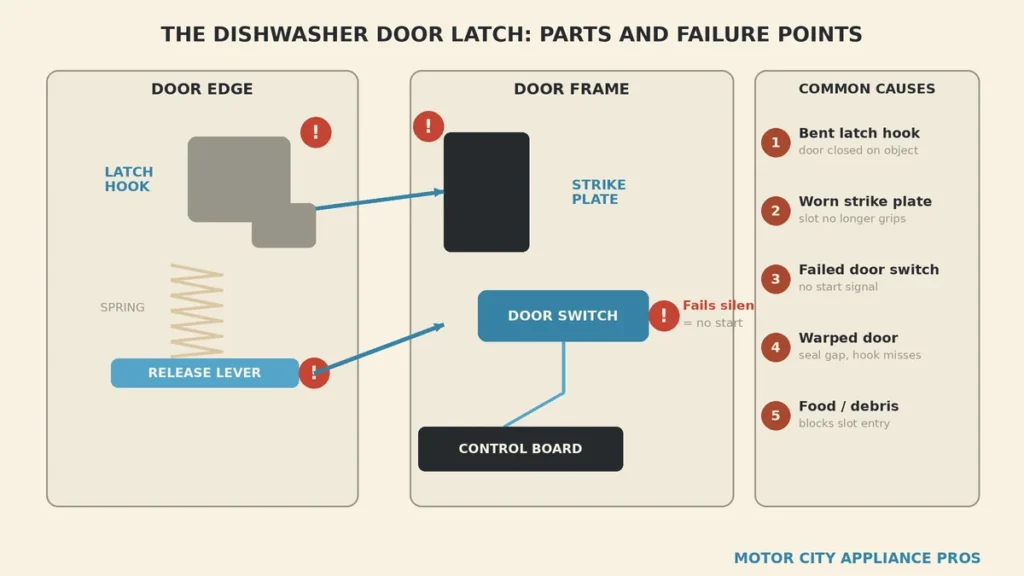
The latch hook and the strike plate are the mechanical side of the system. The door switch is the electrical side. Both have to work together. A perfectly functional switch accomplishes nothing if the hook never engages the strike plate, and a perfectly aligned latch assembly does nothing if the switch has failed and never sends the confirmation signal. Understanding this two part nature of the system is what lets you diagnose a latch problem without guessing.
The Latch Hook: What Breaks and Why
The latch hook is typically a plastic component that attaches to the inside of the door panel near the top. It’s often part of a larger door latch assembly that also includes the handle mechanism and the release lever. Plastic latch hooks break most often from impact: a heavy pot dropped on the open door, a child swinging on it, or closing the door with something caught in the gap. They also wear gradually over years of use, with the tab that locks into the strike plate slowly rounding off until it can no longer hold the door closed under water pressure.
A broken or worn hook usually produces a specific symptom: the door closes and the latch appears to engage, but when the dishwasher starts and water pressure builds, the door pops open slightly or a minute into the cycle. If you have to press the door closed firmly to keep it latched, or if it pops back open on its own when you release it, the hook is the first place to look. Open the door and examine the latch hook visible at the top of the door panel. A broken tab is usually obvious. A worn tab is harder to see but visible as a rounded smooth edge where a sharp corner used to be.
Door latch assemblies are model specific parts but they’re usually straightforward to replace on most dishwasher brands. The inner door panel typically comes off by removing a row of screws around the inside perimeter, and the latch assembly clips or screws into place behind it. The correct part number for your model is essential, since the geometry of the hook varies between brands and models and a near fit won’t latch reliably.
The Strike Plate: The Other Half of the Latch
The strike plate is fixed to the top of the tub opening, and its slot receives the latch hook every time you close the door. It takes the same impact the hook does, and its slot wears over the same timeline. When the plastic slot walls wear down, the hook seats shallowly and doesn’t hold under pressure. When the strike plate itself cracks, it may hold the door at rest but fail during the vibration and water pressure of a cycle.
Food debris is the other strike plate problem. A buildup of grease, dried detergent, or broken food particles in and around the strike slot physically blocks the hook from seating fully. This is an easy and overlooked fix. Before concluding the strike plate needs replacing, clean it thoroughly with a damp cloth and a cotton swab inside the slot. Run a finger along the inside of the slot to feel for anything blocking the full depth. If the door latches properly after cleaning and holds through a cycle, debris was the cause and you’ve fixed it for free.
Door Switches: When the Door Closes but the Machine Won’t Start
If the door closes, the latch clearly engages, the control panel lights up, but the dishwasher simply won’t start a cycle, the door switch is the most likely culprit. The switch is what tells the control board the door is actually closed. When it fails internally, it sends no signal, and the board behaves exactly as it would if the door were still open: it refuses to start.
Door switch failure is particularly common on dishwashers that have seen years of steam and heat cycling through that top frame area. The switch bodies can crack, the contacts inside can corrode, and the plastic actuator that the latch assembly physically presses can break off. The symptom is usually clean: door latches fine, panel works, nothing starts. Some models also display an error code when a door switch fails, so if you see a code you don’t recognise, look it up for your specific brand before doing anything else.
Testing a door switch requires a multimeter and basic comfort with accessing internal dishwasher components. The switch should show continuity when pressed and no continuity when released. Replacing it involves disconnecting two wire terminals and swapping in the new switch, which is a manageable DIY task on most models. The switch is usually accessible once the inner door panel is removed.
A Warped Door or Shifted Tub
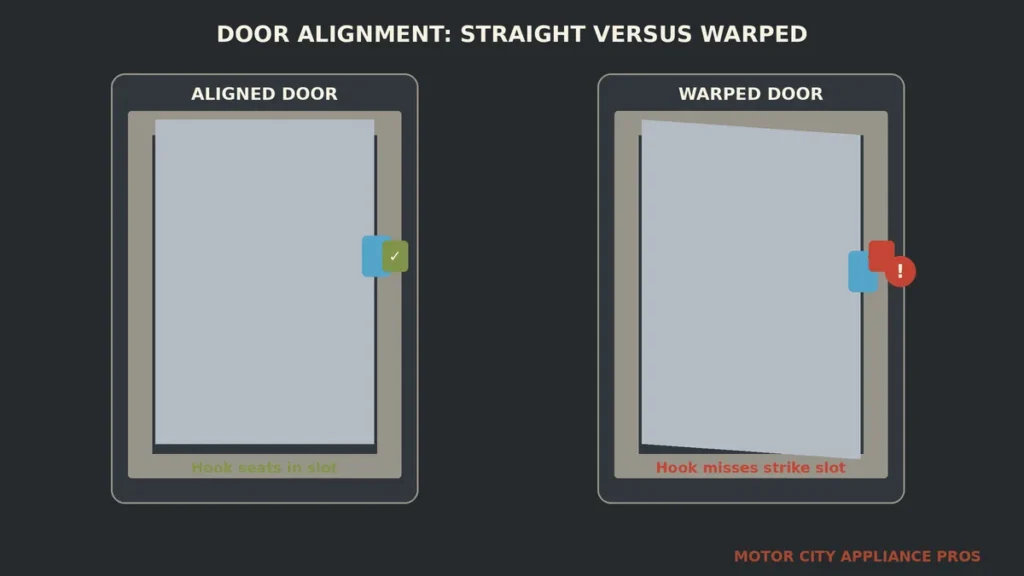
A dishwasher door that warped, a tub that has shifted slightly in the cabinet, or a cabinet that has settled or racked can all move the strike plate and the latch hook out of alignment with each other. When the alignment is off, the hook either can’t reach the slot or hits the edge of the strike plate rather than entering the slot cleanly. The door won’t latch, or it latches with significant force applied that eventually fails or damages the hook.
This kind of misalignment is most visible when you look at the door from the side with it open. A well aligned dishwasher door hangs level and sits squarely inside the cabinet opening. A warped door will show a visible gap on one side, sit lower on one side than the other, or have visible bowing across the panel face. On most built in dishwashers the door can be adjusted by loosening the hinge screws slightly and repositioning the door before retightening. If the tub itself has shifted, which sometimes happens when a dishwasher hasn’t been properly secured to the underside of the countertop, reattaching the mounting brackets is the fix.
The Door Hinge: Wear That Affects Latch Alignment
The door hinges on the lower sides of the dishwasher carry the door through thousands of open and close cycles. When hinge springs weaken or hinge pins wear, the door begins to sag or hang at a slight angle. This shifts the top of the door down or to one side, and the latch hook moves with it, out of alignment with the strike plate. On some models the hinge spring tension is adjustable. On others, the hinge assembly needs to be replaced.
A hinge problem usually shows itself as a door that gradually becomes harder to latch over weeks or months, where previously it latched easily. You might also notice the door doesn’t open as smoothly, that it drops quickly when released, or that it feels heavier than it used to. These are all signs of a spring that’s losing tension rather than a broken latch hook.
What to Check Yourself Before Calling Anyone
Start with the easiest thing: cleaning. Wipe down the latch hook on the door and the strike plate slot on the frame with a warm damp cloth. Use a cotton swab to clear any debris inside the slot opening. Close the door and listen for a clean double click as the latch seats. If it sounds different than it used to, compare it to how it sounds when you press the door in firmly versus letting it close naturally.
Then look at the latch hook directly. Open the door and locate the hook at the top of the door panel, usually visible as a plastic tab or tongue. If it’s clearly broken, the latch assembly needs replacing. If it looks intact, check the strike plate on the frame for debris, cracking, or a slot that looks shallower than it should from wear.
Check the alignment next. With the door open, look at the gap around the full perimeter of the door. It should be roughly even on all sides. Uneven gaps, a door that doesn’t hang level, or a door that you have to lift slightly to close are signs of hinge or alignment issues rather than a broken latch hook.
If the door closes mechanically but the machine won’t start and there are no other obvious issues, the door switch is worth checking. You can feel whether the switch actuator, the small plastic protrusion the latch assembly contacts, is still intact by gently pressing on it with a finger. If it’s broken off flush, the switch won’t register regardless of how well the hook seats.
Michigan Kitchens and Why This Problem Is Common
Hard water throughout much of Michigan leaves scale deposits on every component the water touches, including the area around the strike plate slot. Over months and years, that scale can build up inside the slot and reduce the effective depth it offers the latch hook. A dishwasher that latched fine for years and gradually became harder to close may simply have a slot that’s been narrowed by mineral buildup rather than a broken part. A soak with white vinegar on a cloth pressed into the slot area can help dissolve scale, and in mild cases that alone restores normal latching.
Older Michigan homes are also more likely to have dishwashers installed in cabinets that have settled, shifted, or warped slightly over decades. A kitchen floor that’s no longer perfectly level, a cabinet that’s racked a few millimeters over the years, or an older dishwasher installation where the tub was never mounted to the countertop properly all create the alignment conditions that cause latch problems. If you’ve moved into an older home and the dishwasher has always latched poorly, the installation itself is worth looking at before assuming the latch assembly is to blame.
What the Symptoms Tell You
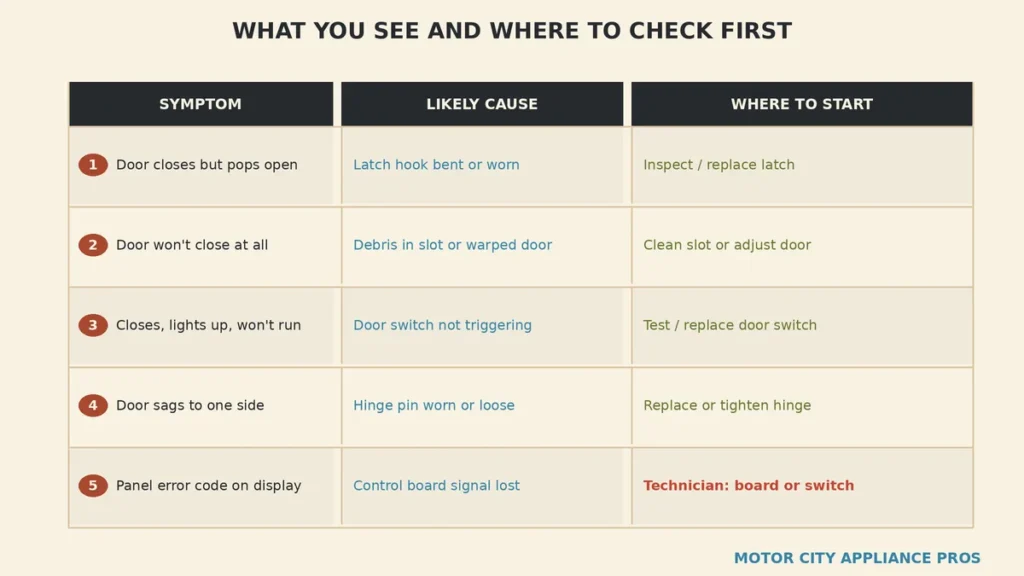
The table above summarises what each symptom points toward. A door that closes but pops open is almost always a mechanical latch issue: a worn or broken hook, a worn slot, or a debris block. A door that won’t close at all usually means something physical is blocking it, like an out of alignment tub, a warped door, or a packed debris buildup. A door that closes and latches but produces no start and no error code is almost always a failed door switch. A door that sags or swings unevenly is a hinge issue. And an error code alongside a close and latch usually means the control board isn’t receiving the switch signal, pointing either to the switch itself or a wiring connection behind it.
When to Call a Technician
Cleaning the strike plate, visually inspecting the latch hook, and checking alignment are all safe things to do yourself. Replacing a door latch assembly on most dishwasher brands is a DIY repair if you’re comfortable removing the inner door panel and working with small plastic components. The door switch is also replaceable by a careful DIYer on most models.
Hinge replacement, tub alignment adjustment, and any diagnosis that involves testing electrical components with a multimeter are better handled by a technician, especially if an error code is involved and you’re not sure which component is generating it. Our dishwasher repair team carries latch assemblies, strike plates, and door switches for the most popular brands and can typically complete a latch repair in a single visit with a 90 day warranty on parts and labor.
If your dishwasher has a door that’s been hard to latch for a while and you’ve also been noticing it smells off, those two problems are sometimes related: a door that doesn’t seal fully lets steam and moisture escape in ways that promote mold and odor in the gasket. Our published article on why a dishwasher smells bad even after cleaning it covers the odor side of that combination in detail.
Dishwasher Repair Across Michigan
Motor City Appliance Pros serves Michigan homes throughout the state, and our technicians carry dishwasher latch parts for the most common brands on every service truck. In the south Oakland County area, our Southfield appliance repair team handles same day dishwasher calls across that part of the metro. Across the river in Wayne County, our Romulus appliance repair technicians provide the same same day service with the same 90 day warranty.
Wherever you are in Michigan, you’ll get a technician who checks the hook, the strike plate, the switch, and the alignment in a logical order, shows you exactly what they find, and gives you a firm price before starting any repair. A dishwasher latch problem feels like a complete lockout because it is one. But it’s almost always a small mechanical part away from being solved.
So, why won’t your dishwasher door latch or lock shut? Because the hook, the slot, the switch, or the alignment between them has failed. Work through the symptoms in order, start with cleaning and a visual check, and you’ll almost always identify the cause before you’ve spent a penny.
Frequently Asked Questions
Can I run my dishwasher if the door won’t latch all the way?
No. A dishwasher that won’t latch won’t start, and you shouldn’t try to bypass this. The door latch and switch system is what prevents the machine from spraying hot water out of the door opening during a cycle. Bypassing it or forcing the door closed with tape or pressure risks a flood and potential damage to the control electronics if water reaches them.
My dishwasher door latches but the machine still won’t start. What’s wrong?
This is almost always the door switch. The hook is seating in the strike plate, but the switch that should confirm the closure to the control board isn’t firing. Check whether the switch actuator is intact and whether any error code is showing on the panel. A technician can test the switch with a multimeter in a few minutes.
How long does a dishwasher door latch assembly last?
A well made latch assembly on a quality brand dishwasher can last the full life of the machine, often ten to fifteen years. Budget brands and machines that see heavy daily use with forceful door closing tend to see latch wear after five to eight years. Closing the door firmly but not slamming it, and never allowing children to swing on the open door, extends latch life significantly.
Can food debris really stop a dishwasher door from latching?
Yes, and it’s more common than people expect. The strike plate slot is a narrow opening and it’s right at the top of the tub where grease and splatter can accumulate. Enough buildup in that slot stops the hook from seating fully. This is the first thing worth trying before assuming a part needs to be replaced, and it’s free.
Why does my dishwasher door latch but pop open mid cycle?
A door that latches at the start but pops open once water pressure builds usually has a worn latch hook. The hook seats in the slot but doesn’t have enough depth engagement to hold against the pressure differential that builds inside the tub during a cycle. The latch assembly needs to be replaced.
My dishwasher is new and the door already won’t latch properly. Is that a defect?
It could be. On a newly installed dishwasher, a door that won’t latch is usually an installation issue rather than a defective part. Check whether the tub is secured properly to the underside of the countertop and whether the door hangs level. A tub that’s tilted even slightly in the cabinet cavity can misalign the latch from day one. Contact the installer or the retailer before assuming a warranty claim is needed.