
Your microwave door won’t stay closed or latch because one or more of the plastic hooks on the door edge have broken, the slots in the frame that those hooks catch are worn or clogged, the door hinge has shifted so the door no longer lines up correctly, or a door interlock switch has failed and the microwave simply won’t run even though the door appears physically closed. These are the four categories almost every latch problem falls into, and the fix for each one is completely different.
A microwave that won’t latch or stay shut is more than an inconvenience. The latch mechanism is directly tied to the safety interlock system that prevents the microwave from generating radiation with the door open. When the latch fails, the microwave either refuses to start at all, or in rarer cases on older units, it can actually run with the door not fully sealed. Neither situation is acceptable, and both are worth addressing promptly rather than propping the door shut and hoping for the best.
At Motor City Appliance Pros, we repair microwave door latch systems on countertop units, over the range microwaves, and built in models across Michigan. This guide explains how the latch system works, what each type of failure looks and feels like, and what you can safely check yourself before calling a technician.
How the Door Latch System Actually Works
Most microwaves use a simple but precisely engineered mechanism. The door has two or three plastic hooks that project from its right or bottom edge. When the door closes, those hooks slide into corresponding slots cut into the frame of the oven cavity and push against small spring loaded tabs that hold them in place. At the same time, those hooks press against a set of micro switches, typically two or three, mounted inside the door frame, that signal to the microwave’s control system that the door is properly shut and it is safe to operate.
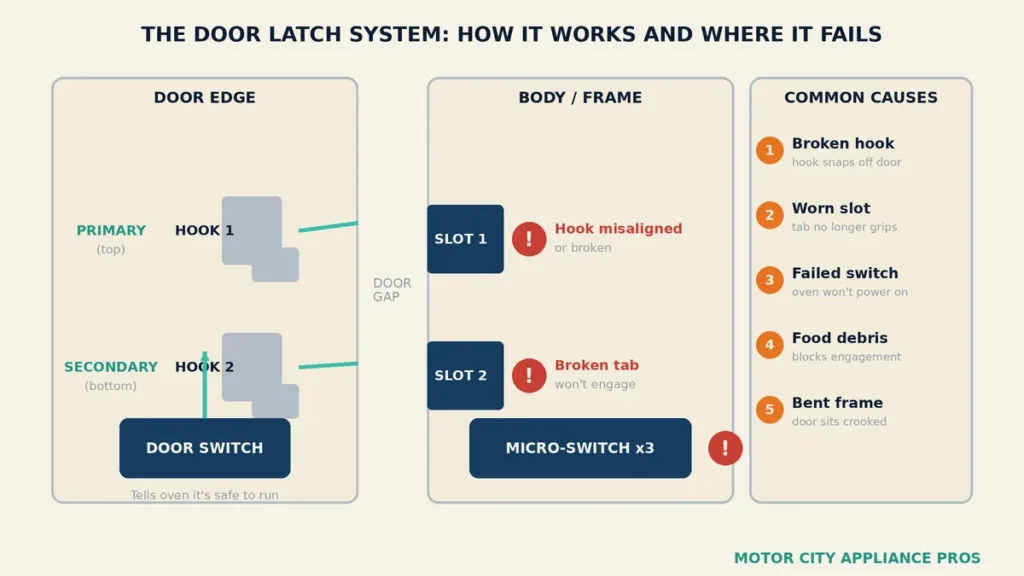
The entire system depends on precise alignment. The hooks have to line up exactly with the slots. The slots have to grip firmly enough to hold the door closed but release cleanly when the door release button is pressed. And the switches have to actuate fully and reliably every single time. If any one component in this chain fails, the microwave either won’t stay closed or won’t operate even when it appears to be closed.
What makes this tricky is that the plastic parts involved are relatively inexpensive components doing a demanding job. Every time you close the microwave door, those hooks and slots take the impact. Over thousands of cycles, they wear, flex, and eventually break. The microwave door is arguably the most used moving part on any kitchen appliance, and the latch absorbs every closing.
Broken Door Hooks: The Most Common Cause
The latch hooks on the door are made of hard plastic and they snap. This happens more often than most people expect, and it usually happens not from slamming the door but from the cumulative stress of the door being closed slightly off angle, or from the door being pushed past the natural stopping point repeatedly. A broken hook is usually visible if you look closely at the right edge of the open door. You’ll see a nub where a tab used to be, or a tab that clearly doesn’t reach as far as it should.
When the primary latch hook breaks, the door may still close but won’t hold. It pops open with the slightest pressure, or it closes and the microwave displays a door error and refuses to start. When a secondary hook breaks, the door might still hold in place but will wobble slightly, and the switch it was responsible for activating may not engage reliably.
Replacing latch hooks requires a door latch assembly specific to your model number. On most countertop microwaves it involves removing a few screws from the door panel to access the inner door assembly, replacing the latch component, and reassembling. It’s a manageable repair if you’re comfortable with a screwdriver and careful with small plastic parts. On over the range and built in models, door access is more involved.
Worn or Damaged Latch Slots in the Frame
The other side of the latch equation is the frame slots that the door hooks catch on. These are usually made of harder plastic or sometimes reinforced material, but they still wear over time, and they can crack or chip especially if the door has ever been closed on something stuck in the opening, like a piece of food or a bag that caught in the frame. When the slot wears down or cracks, the hook has nothing solid to grip, and the door either doesn’t hold closed or requires increasing force to stay shut.
Food debris is another slot problem that gets overlooked. Dried splatter or grease buildup around the latch opening can be thick enough to physically prevent the hook from seating fully. Before assuming the slots are damaged, clean the entire latch area thoroughly with a damp cloth and a cotton swab, paying attention to the inside of each slot opening. Sometimes that alone resolves a door that has been getting progressively harder to latch.
The Three Door Interlock Switches
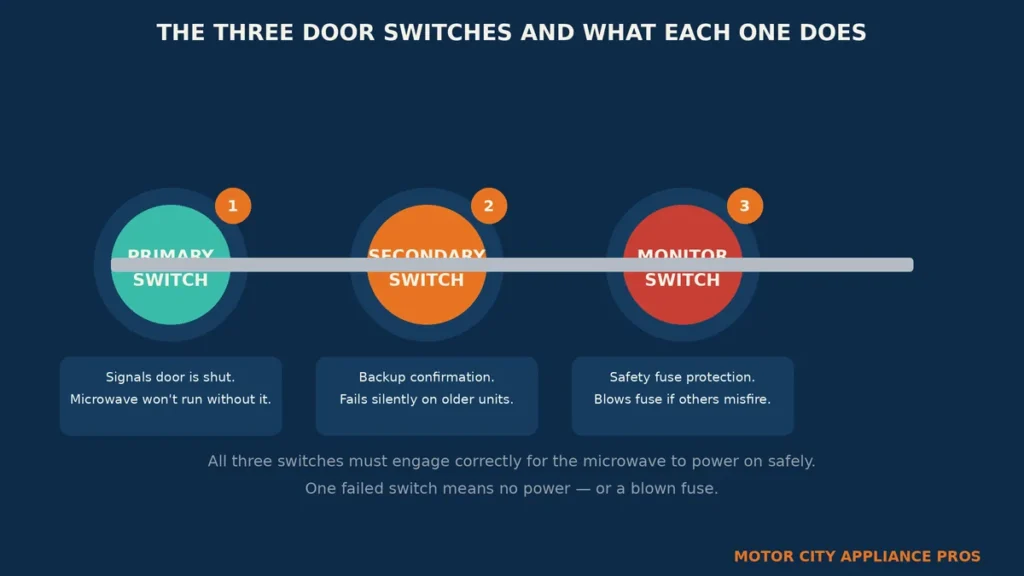
This is the piece of the puzzle most homeowners don’t know exists. Most microwaves have three separate micro switches mounted inside the door frame, directly in the path of the latch hooks. They are called the primary switch, the secondary switch, and the monitor switch, and all three need to work correctly for the microwave to operate safely.
The primary switch is the one that directly signals the microwave to allow power to the magnetron. If it fails or doesn’t fully actuate because the hook isn’t reaching it, the microwave shows no response or displays a door error. The secondary switch is a backup confirmation that the door is closed. It often fails silently, meaning the microwave may still run but the switch is no longer providing its confirmation signal, which creates an unreliable safety condition. The monitor switch is a safety fuse protector. If the primary and secondary switches somehow both fail to open when the door is opened, the monitor switch is designed to blow the main fuse, cutting power to the oven completely.
A microwave that clicks when you close the door, shows power on the display, but simply won’t start when you press a cook button is often pointing to a failed or misaligned door switch rather than a broken hook. The door appears closed because it physically holds in place, but the switch isn’t getting pressed fully enough to register. Testing door switches requires a multimeter and the willingness to work near capacitor components that hold dangerous voltage even when unplugged. Door switch replacement is a job best left to a qualified technician for this reason.
Door Hinge Problems and Frame Misalignment
On over the range microwaves, which are mounted on the wall above a stove, the door hangs from hinges on the left side and latches on the right. These hinges carry the full weight of the door through thousands of open and close cycles. When a hinge pin wears or bends, the door begins to sag. A sagging door sits lower than it was designed to, which means the hooks on the right edge no longer line up with the slots in the frame. The door may close with effort, or it may not close at all.
A simple test for this: open the door fully and look at the hinge pins on the left side. The door should hang level and feel firm when you lift it slightly. A door that drops noticeably when you let go, or that feels loose side to side, has a hinge problem. Hinge replacement on over the range models requires removing the door, which varies in complexity by brand. Some models allow hinge replacement without removing the microwave from the mounting bracket; others require full removal.
Frame warping is less common but can happen if the microwave has taken a bump, if a very heavy object has been rested on an open door, or in older units where the sheet metal has simply fatigued. A visibly bent cavity frame around the latch slots is not repairable by tightening anything. The frame itself would need replacement or professional assessment of whether the unit is still safe to operate.
What the Symptom Tells You Before You Touch Anything
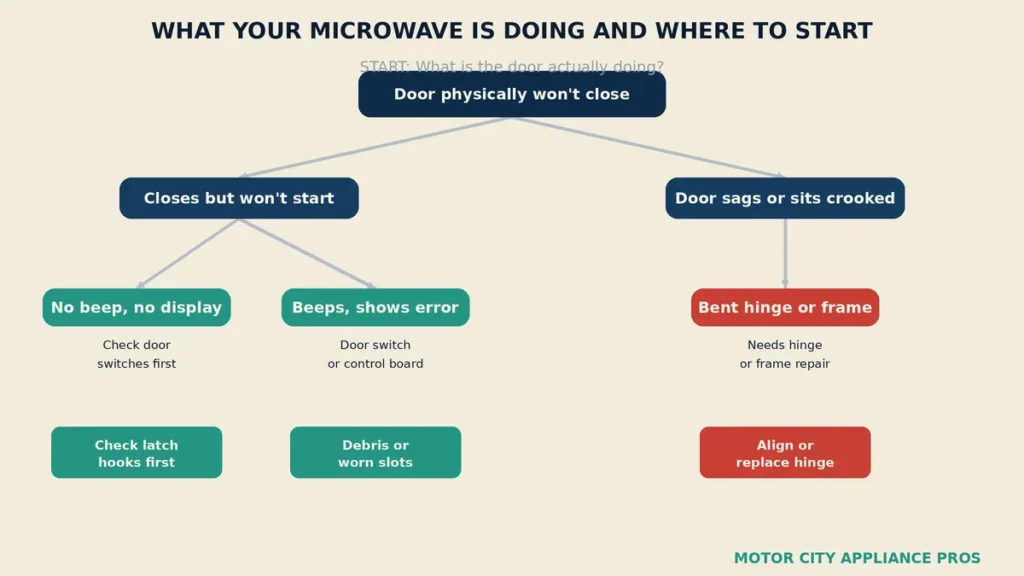
Working through the decision path above before reaching for a screwdriver saves time and helps you explain the problem accurately. A door that physically won’t close at all, that stops before reaching the frame, is almost always a broken hook, a worn slot, or food debris. A door that closes and holds but the microwave won’t run points to a switch problem. A door that wobbles, sits at an angle, or sags when open is a hinge issue. Each of these paths leads to a different repair and a different level of DIY accessibility.
What You Can Safely Check and Clean Yourself
Cleaning the latch area is always a safe first step. Unplug the microwave, then wipe down the entire door edge and the latch slot area on the frame with a damp cloth. Pay attention to the inside of each slot opening and use a cotton swab to clear any buildup from grease or dried splatter. Do the same around the door seal, since debris along the door edge can prevent the door from sitting flat against the frame.
Then inspect the hooks visually. Open the door and look at the right edge, or wherever the hooks are on your model. A broken hook is usually obvious once you know what you’re looking for. Count the hooks and compare them: a hook that’s shorter than the others, or that has a rough edge where plastic has sheared, is broken. Look at the corresponding slot and check for cracking or obvious wear around the opening.
If the door closes but the microwave won’t start, try pressing the door firmly and evenly while pressing the start button. If the microwave starts when you push the door in firmly, the hooks are not reaching the switches reliably, which narrows it to either a slightly short hook, a worn slot, or a misaligned door. This test is for diagnosis only and not a long term workaround. Pressing on the door during operation is not safe practice.
Michigan Kitchens and Why This Problem Is Common Here
Over the range microwaves are especially prevalent in Michigan homes because they combine the microwave and range hood into one unit, a practical choice for the kitchen sizes common in our mid century and postwar housing stock. These units handle far more daily use than a countertop model, and their doors are opened from a lower angle, which puts more stress on the hinge and latch every time. A family cooking three meals a day from an over the range microwave is putting its door through more wear in a year than a countertop unit in a college dorm sees in five.
Older Michigan homes also tend to have tighter kitchen layouts where the microwave is mounted lower than ideal, which means more awkward opening angles and more casual closing. The number of times a latch breaks because the door was swung shut from the side rather than pushed straight in is higher than most people would guess. Over the range models in kitchens with low clearance get caught in this pattern constantly.
Safety Note: Do Not Use a Broken Latch as a Workaround
It bears saying directly. Using a rubber band, tape, a bungee cord, or any external mechanism to hold a microwave door closed while the unit runs is dangerous. It bypasses the interlock system that ensures the door is sealed correctly, and microwave radiation escaping from an improperly sealed door is a genuine health risk. If the latch is broken, stop using the microwave until it’s repaired. The repair cost is small relative to the risk of operating a microwave with a compromised door seal.
When to Call a Technician
Cleaning the latch area and visually inspecting for a broken hook are safe DIY tasks. Replacing a door latch assembly on a countertop model is within reach for a careful homeowner with the right model specific part. Anything involving the door switches, the hinge on an over the range model, or a frame alignment issue is best handled by a technician, both for safety reasons and because the correct diagnosis often requires testing components with a meter while working near high voltage capacitor circuits.
Our microwave repair team services countertop, over the range, and built in microwave door systems across Michigan with same day appointments and a 90 day warranty. If the latch issue has also caused a blown fuse inside the microwave, which is a common side effect of a door switch failure, our technicians carry the fuses and switch assemblies for the most popular brands and can usually complete both repairs in one visit.
If you’ve also been noticing that the microwave runs but doesn’t heat properly alongside the door issue, those two problems are sometimes connected when a switch is failing intermittently. Our published article on why a microwave turntable is spinning but not heating food covers the heating side of microwave faults in detail and is worth reading alongside this one.
Microwave Repair Across Michigan
Motor City Appliance Pros services microwaves throughout Michigan, from countertop replacements to full over the range door hinge and latch rebuilds. In the Clinton Township area, our Clinton Township appliance repair team handles same day microwave calls throughout Macomb County. In the western suburbs, our Farmington Hills appliance repair technicians cover Oakland County on the same terms.
Wherever you’re calling from, you get a technician who checks the hooks, the slots, the switches, and the hinge alignment in a logical order, explains what they find in plain language, and gives you a clear price before starting any work. A microwave that won’t latch is one of the more straightforward appliance repairs once you know which component has actually failed. We’ll find it and fix it.
So, why won’t your microwave door stay closed or latch? Because one of four things has happened: a hook broke, a slot wore out, a switch failed, or the door hinge shifted. The symptom pattern tells you which one before you even open a panel. Start with what you can see and clean safely, and call someone for anything that takes the door apart or involves the switches.
Frequently Asked Questions
Is it dangerous to use a microwave with a door that doesn’t latch properly?
Yes. A door that doesn’t latch correctly may not be fully sealed, which allows microwave radiation to escape. It also bypasses the interlock switches that prevent the magnetron from operating with an open door. Stop using the microwave and have the latch repaired before running another cycle.
Why does my microwave door close but the unit still won’t start?
This almost always points to a door interlock switch that isn’t being fully actuated. The door appears closed because the hook seats in the slot, but the hook isn’t reaching the switch behind it. Causes include a slightly worn hook, a worn slot that lets the hook sit slightly shallow, or a switch that has failed internally. A technician can test the switches quickly with a multimeter.
Can I replace a broken latch hook myself?
On many countertop models, yes. You’ll need the correct latch assembly for your model number, a screwdriver, and patience with small plastic components. The inner door panel usually comes off with a handful of screws, and the latch assembly clips or screws into place. On over the range and built in models the process is more involved and varies significantly by brand.
How many door switches does a microwave have and which one is most likely to fail?
Most microwaves have two to three door interlock switches. The primary switch is the most critical and the most likely to cause a complete no start condition when it fails. The secondary switch often fails more quietly, and the monitor switch failure is usually announced by a blown main fuse rather than a simple no start.
My microwave door sags when I open it. Is that a latch problem?
A sagging door usually points to a worn or bent door hinge rather than the latch itself. When the hinge wears, the door drops lower than its design position, which means the hooks no longer align with the slots in the frame. This is more common on over the range models where the door hangs from side hinges and carries more weight over time.
How long should a microwave door latch last?
There’s no fixed lifespan, but the plastic latch hooks are typically the first mechanical component to fail on a microwave that gets heavy daily use. An over the range microwave in an active kitchen might see its latch hooks start to wear after five to eight years. A countertop model used only occasionally might go fifteen years without any latch issue. Closing the door squarely and avoiding slamming it extends latch life considerably.