
Your ice maker’s water line is freezing up because some part of the narrow tube that carries water from the wall to the ice maker is sitting in air that’s cold enough to turn that water to ice before it finishes its journey. It’s one of the more frustrating fridge problems precisely because the symptoms can look like a dozen different things, from an ice maker that simply stops working, to cubes that come out hollow or undersized, to a solid block of ice forming in a spot you didn’t even know had water in it.
In Michigan, this problem shows up more often than it does in warmer states, and for good reason. Our winters push freezer compartments, unheated utility spaces, and exterior wall cavities into temperature ranges that can freeze a trickle of standing water in the time it takes to run one load of laundry. If your ice maker quit working and you’re wondering why, a frozen water line is one of the first things worth checking.
At Motor City Appliance Pros, we see frozen lines on everything from older Whirlpool side by sides to newer French door fridges, and the cause is almost always one of a short list of repeat culprits. This guide walks through each one, how to tell them apart, and what you can do about it before calling someone.
Understanding the Water Line and Where It Goes
Most homeowners know their fridge has a water line, but few know exactly where it runs. The line starts at a shutoff valve behind or under the fridge, connects to the wall supply, and then travels through or around the back of the cabinet until it reaches the water inlet valve on the fridge itself. From there a second, shorter tube called the fill tube carries water up into the freezer compartment where the ice maker tray sits. That whole journey covers several feet and passes through at least two or three distinct temperature zones along the way.
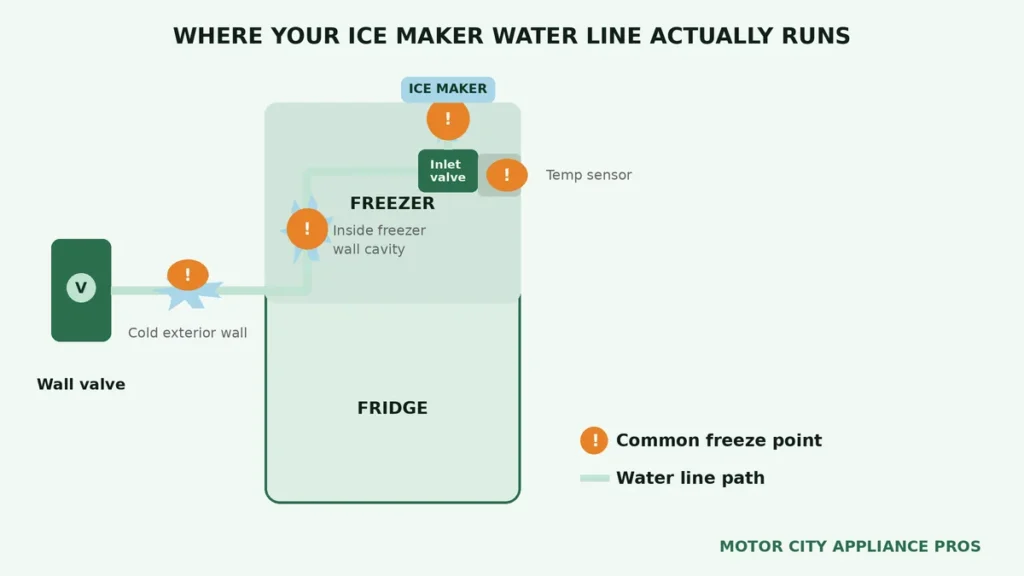
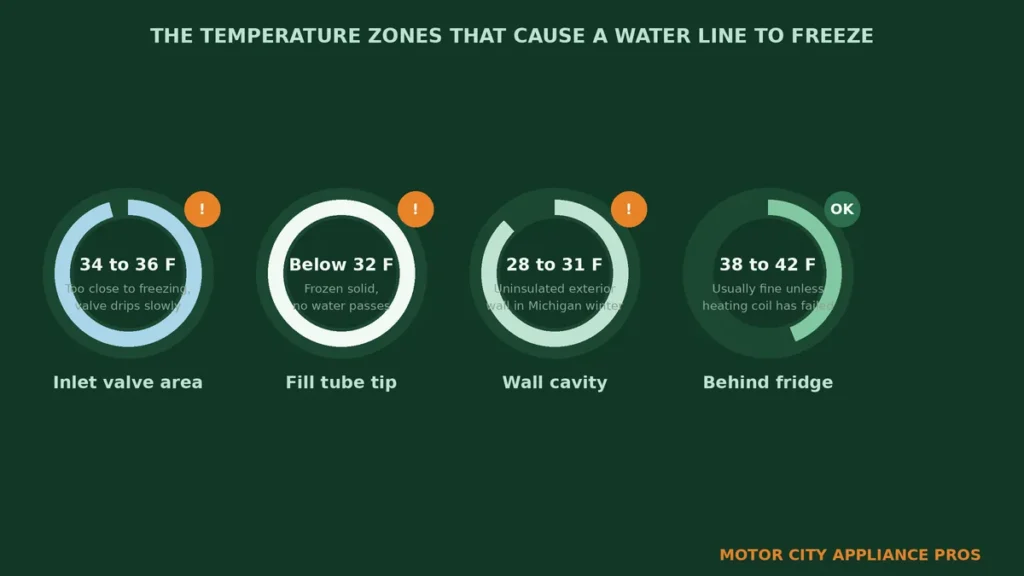
Each of those zones is a potential freeze point, and the fix for each one is different. Water sitting still in the line between ice making cycles is especially vulnerable, since flowing water is harder to freeze than standing water. A line that drips a small amount between cycles or that barely moves because demand is low gives cold air the time it needs to do real damage.
The Fill Tube: Freeze Point Number One
The fill tube is the short plastic or rubber tube that delivers water directly from the inlet valve to the ice maker mold. It’s exposed to the full cold of the freezer compartment, which is normally a few degrees below zero Fahrenheit. Because it sits right inside the freezer and carries only a small amount of water at the end of each fill cycle, any water left sitting at the tip of that tube after filling is done can freeze before the next cycle begins.
Once the tip freezes, subsequent fill cycles can’t push water through. Water backs up, more ice forms around the blockage, and what started as a thin skin of ice at the tip becomes a solid plug over several cycles. The symptom you’ll usually see is an ice maker that has completely stopped making ice even though everything else on the fridge seems fine. If you open the freezer and look at the fill tube, which is usually a thin white or clear tube pointed at the ice maker tray, you may see it capped with ice or surrounded by a frost buildup that isn’t present elsewhere in the freezer.
The temporary fix is to defrost the tube. Unplug the fridge, let the freezer warm up naturally for a few hours, or use a hair dryer on a low setting held at a safe distance. Do not use a knife or anything sharp to chip ice out of a fill tube. Once it’s clear, the permanent question is why it froze in the first place, which comes down to either a freezer set too cold, a faulty fill tube heater, or an inlet valve that’s leaving a small drip of water in the tube after each fill cycle.
Freezer Temperature: The Setting That Causes More Problems Than You’d Expect
Most ice makers are designed to work with a freezer temperature between 0 and 5 degrees Fahrenheit. Set it colder than 0 and the fill tube tip has almost no tolerance for any standing water at all, since the surrounding air is already working against it even when the heater coil is functioning. We see this more than you might expect, usually after someone adjusted the temperature because their ice cream wasn’t hard enough, or because they assumed colder always means better.
Check your freezer control and aim for 0 to 2 degrees Fahrenheit. If you have a digital display, that number is easy to confirm. If your fridge uses a dial marked one through seven or cold through coldest, a middle setting is usually closer to the right range than the maximum. Some fridges also have separate controls for the freezer and the fresh food section, and the two can interact in ways that push the freezer colder than the dial suggests if both are turned up.
The Fill Tube Heater: What It Is and Why It Fails
Most modern refrigerators include a small heater element wrapped around or embedded near the fill tube specifically to prevent this freezing problem. The heater runs briefly during or after each fill cycle to keep the tip of the tube warm enough that standing water can’t solidify. When that heater fails, the tube is left unprotected between cycles, and it usually starts freezing within a few days, faster in cold weather.
A failed fill tube heater is one of the more common things we replace on service calls for a non working ice maker. The heater itself is usually inexpensive, but reaching it requires removing the ice maker assembly and sometimes the back panel inside the freezer. If your ice maker stopped working and you’ve confirmed the fill tube keeps icing over even after defrosting and setting the temperature correctly, a failed heater is the most likely explanation.
The Inlet Valve: A Slow Drip Makes Everything Worse
The water inlet valve is the solenoid valve on the back of the fridge that opens briefly during each ice making cycle to let water in, then closes to stop the flow. A valve that’s slightly worn or has a small piece of mineral scale stuck in it doesn’t always close fully. The result is a slow drip of water that continues to trickle into the fill tube after the cycle is done. That slow drip collects at the tip of the fill tube, sits in freezer temperature air, and turns to ice.
A dripping inlet valve tends to produce a specific pattern. You’ll often see the ice maker producing smaller than normal cubes before it stops entirely, since early in the problem the drip adds some water to the tray but not the full amount. You might also see a puddle of ice on the bottom of the freezer under the ice maker, which forms from overflow that missed the tray. Inlet valves on older fridges are often worth replacing as part of a broader service visit, since a valve that’s dripping in one zone will often start failing in others.
The Exterior Wall and the Line Behind the Fridge
Before water even reaches the inlet valve, it has to travel through the supply line from the wall. In many Michigan homes, that line runs along or through an exterior wall cavity on its way to the fridge. Exterior walls in our climate can drop to temperatures well below freezing in January and February, especially in older homes with minimal insulation in the wall cavities. A plastic or copper supply line sitting in that air with little to no water moving through it between ice cycles is a genuine freeze risk.
The telltale sign for this type of freeze is timing. If your ice maker stops working reliably only in winter and comes back to normal in spring without any repairs, the line behind the wall or behind the fridge is a strong suspect. Pulling the fridge out from the wall and checking whether the supply line runs along a cold exterior surface is the first step. Foam pipe insulation, available at any hardware store, can wrap the line where it runs through a cold area and usually solves this for good.
How Michigan Winters Make This Worse Than Anywhere Else
A water line freeze that might happen once or twice a year in a mild climate can become a monthly problem in Michigan winters. The temperature difference between a freezer compartment running at zero degrees and an unheated basement or exterior wall running at ten or fifteen degrees is a much smaller buffer than most people realize. Water that barely makes it through the fill tube on a November day simply doesn’t make it through in January when the ambient temperature around that tube has dropped another twenty degrees.
Older homes across Detroit and its suburbs, with plaster walls and minimal cavity insulation, are particularly prone to this. So are utility closets on exterior walls, garage kitchens, and any setup where the fridge was pushed into a tight corner with a cold air return or a drafty area nearby. If you’ve moved into an older Michigan home and the previous owners never mentioned ice maker trouble, it’s worth checking the supply line path in your first winter rather than discovering it during a dinner party.
Diagnosing Which Freeze Point Is Yours
The quick reference below summarizes what each freeze location looks like in practice, so you can narrow down the cause before spending time on the wrong fix.
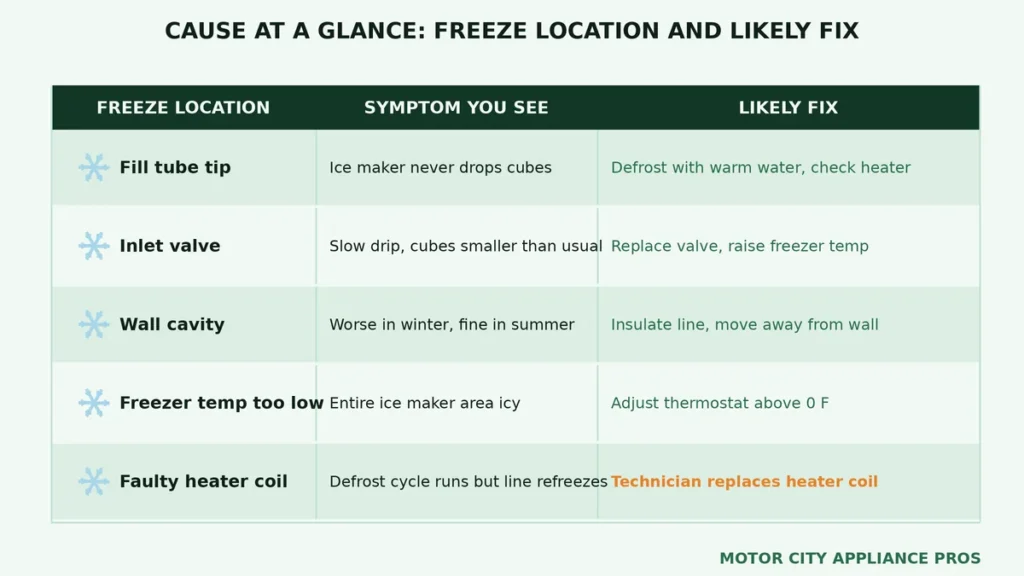
A few additional clues help narrow things down. If the problem only shows up in cold months and goes away on its own in spring, look at the supply line path and exterior wall exposure. If the ice maker stops working year round, the fill tube heater or inlet valve are more likely causes. If ice production gradually slows over a few days before stopping entirely, the inlet valve drip pattern is a strong match. If the ice maker stops suddenly with no warning, a solid freeze at the tip of the fill tube is the most common explanation.
What You Can Do Before Calling a Technician
There are a few things safe and straightforward enough to try yourself. First, confirm the freezer temperature is set between 0 and 5 degrees Fahrenheit and give the fridge 24 hours to stabilize before assuming the temperature is the problem. Second, if you suspect a frozen fill tube, unplug the fridge and let the freezer thaw for several hours to see if ice production returns. If it does, you’ve confirmed the tube was frozen and can work on the underlying cause.
Third, pull the fridge away from the wall and inspect the supply line. Check whether it runs along a cold surface, whether it has any kinks that slow water flow and increase freeze risk, and whether the valve at the wall feels damp or shows mineral buildup around the connection. Wrapping exposed sections with foam pipe insulation is a low cost first step that sometimes eliminates the problem entirely on exterior wall runs.
What to avoid: using sharp objects to chip ice out of any component, pouring boiling water anywhere near the ice maker or its components, and running the ice maker immediately after a defrost without giving the system time to reach operating temperature. Each of these can cause more damage than the original freeze.
When the Fix Needs a Technician
Replacing a fill tube heater, diagnosing a failing inlet valve, or dealing with a freeze deep inside the freezer wall cavity typically requires removing the ice maker assembly and the back panel of the freezer compartment. These are jobs that need the right tools and, in the case of the inlet valve, parts specific to your make and model. Attempting them without experience often leads to cracked plastic panels, damaged wiring harnesses, or a valve replaced with the wrong part.
Our ice machine repair team handles frozen lines, failed heaters, and inlet valve replacements regularly, with same day service and a 90 day parts and labor warranty. If your fridge has also been running warmer than usual or has a compressor that seems to run constantly, those symptoms may be connected, and our refrigerator repair technicians can look at the full picture at the same visit.
If you’re also noticing your ice cubes coming out cloudy or hollow before production stopped entirely, our guide on why an ice maker produces cloudy or no ice covers that specific symptom set in detail and is worth reading alongside this one.
Ice Maker Repair Across Michigan
Motor City Appliance Pros services refrigerators and ice makers throughout Michigan, and our technicians stock the fill tube heaters, inlet valves, and supply line parts that solve most of these calls in a single visit. In the western suburbs, our Romulus appliance repair team handles same day calls across that part of the state. On the south side, our Southgate appliance repair technicians are available on the same terms.
Wherever you’re calling from, you’ll get a technician who traces the line from the wall valve to the ice maker tray, identifies exactly where the freeze is happening, and gives you a clear price before touching anything. A frozen water line feels like a mysterious failure. In practice, it almost always comes down to one of the five causes above, and we’ve fixed each of them more times than we can count.
So, why is your ice maker’s water line freezing up? Because somewhere between the wall and the ice maker tray, a section of that line is sitting in air cold enough to freeze standing water, with nothing stopping it. Find the zone, fix the temperature or the heater, and the ice will come back.
Frequently Asked Questions
How do I know if my ice maker water line is frozen versus something else being wrong?
The clearest sign is an ice maker that stops completely while the rest of the fridge works normally. If you look at the fill tube inside the freezer and see ice capping the tip or heavy frost around the connection, the line is frozen. Defrosting the fridge confirms it: if ice production returns after a full defrost and then stops again within a few days, a frozen line is almost certainly the cause rather than a failed ice maker module.
Can I fix a frozen ice maker water line myself without any tools?
The defrost step is something most people can do safely: unplug the fridge, leave the freezer door open for several hours, and let the ice melt naturally. That clears the immediate freeze. Solving the underlying cause, whether it’s the freezer temperature, the fill tube heater, or the supply line routing, usually requires either a simple setting change or, for part replacements, at least a screwdriver and some patience. Anything involving the inlet valve or the panel inside the freezer is generally worth leaving to a technician.
What temperature should I set my freezer to prevent the water line from freezing?
Between 0 and 5 degrees Fahrenheit is the standard range for ice maker operation. Setting the freezer colder than 0 increases the risk of the fill tube freezing between cycles, especially if the fill tube heater is starting to weaken. If your fridge uses a one through seven dial, a middle to upper middle setting usually lands in the right range, though this varies by model.
Why does my ice maker only freeze up in winter?
A seasonal freeze almost always points to the supply line path through a cold area of the home, usually an exterior wall cavity, an unheated basement, or a utility room with poor insulation. In Michigan winters, these spaces can drop far enough below freezing to ice a supply line that moves through them. The fix is insulating the exposed section of line with foam pipe insulation, which is inexpensive and installable without any special tools.
Is a frozen water line a sign my fridge needs to be replaced?
No, not by itself. A frozen line is almost always a component failure or a routing issue, not a sign that the fridge as a whole is failing. Fill tube heaters and inlet valves are relatively low cost repairs, and insulating a supply line costs even less. Replacement only starts to make sense when the fridge has multiple failing systems at once or when the repair cost approaches a significant fraction of the replacement cost.
Can a frozen water line damage other parts of the refrigerator?
If left long enough, yes. A frozen fill tube that backs water up into the inlet valve can stress the valve’s solenoid and shorten its life. Ice buildup inside the freezer around the fill tube area can obstruct the evaporator fan or ice maker mechanism if it grows large enough over multiple freeze and partial thaw cycles. Addressing the freeze promptly rather than waiting for it to resolve on its own is always the better approach.