
How often you should clean your dryer vent comes down to a fairly simple answer for most Michigan households: once a year is the baseline, and every six months is smarter if you run more than four or five loads a week, have pets, or your vent line runs a long or winding path through the house. That’s not a maintenance suggestion pulled out of thin air. Clogged dryer vents cause thousands of residential fires across the United States each year, and failure to clean is consistently identified as the leading factor behind them. The good news is this is one of the most preventable appliance hazards there is, and knowing the warning signs matters just as much as knowing the schedule.
This guide covers how often to actually clean based on your specific household, why Michigan homes face a few extra risk factors, the warning signs that mean your vent is overdue right now, and what the cleaning process actually involves.
Why Dryer Vents Catch Fire in the First Place
Every load of laundry sheds lint. Most of it gets caught by the lint trap, but a meaningful portion travels past it and settles along the inside walls of the vent duct running from the back of your dryer to the exterior of your house. Lint is essentially dry, finely shredded fabric fiber, which makes it one of the most flammable materials sitting anywhere in your home.
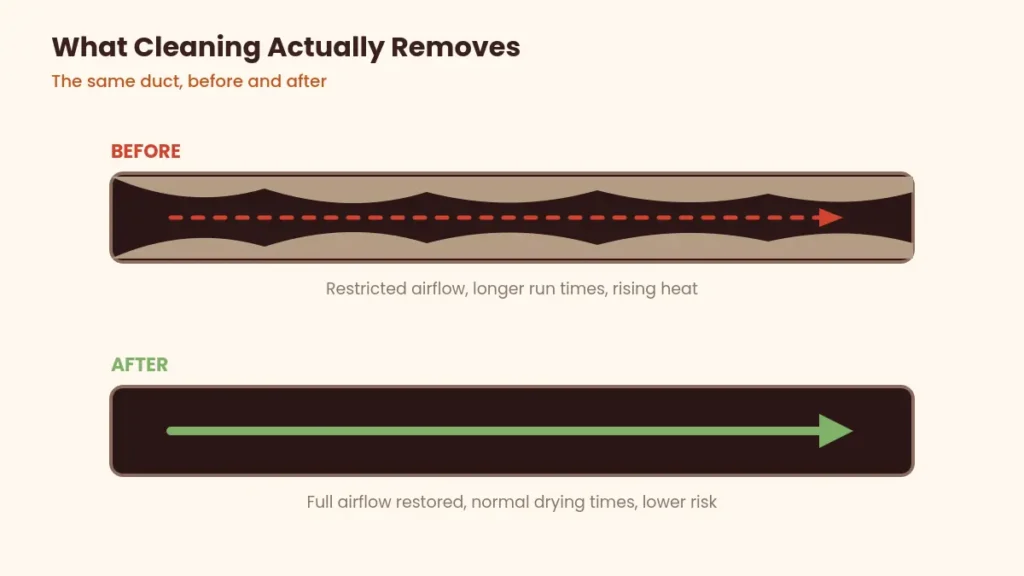
As that lint accumulates, it does two dangerous things at once. It restricts airflow, which forces the dryer to run hotter and longer to dry the same load, and it provides a continuous fuel path for any ignition source. When a dryer’s internal temperature climbs high enough because it can’t exhaust heat properly, and there’s a duct packed with dry fiber sitting right there, you have the two ingredients a fire needs. This is why the fix is preventive rather than reactive, by the time you smell something burning, the situation has already progressed further than anyone wants.
What makes this particularly worth taking seriously is how gradual the buildup is. Nobody wakes up one morning to a suddenly clogged vent. It accumulates load by load over months and years, and because the performance decline is so slow, most people adjust to it without noticing, running an extra cycle here and there and assuming the dryer is just getting older. That slow adaptation is exactly why scheduled cleaning matters more than waiting for something to feel obviously wrong.
The Actual Cleaning Schedule by Household Type
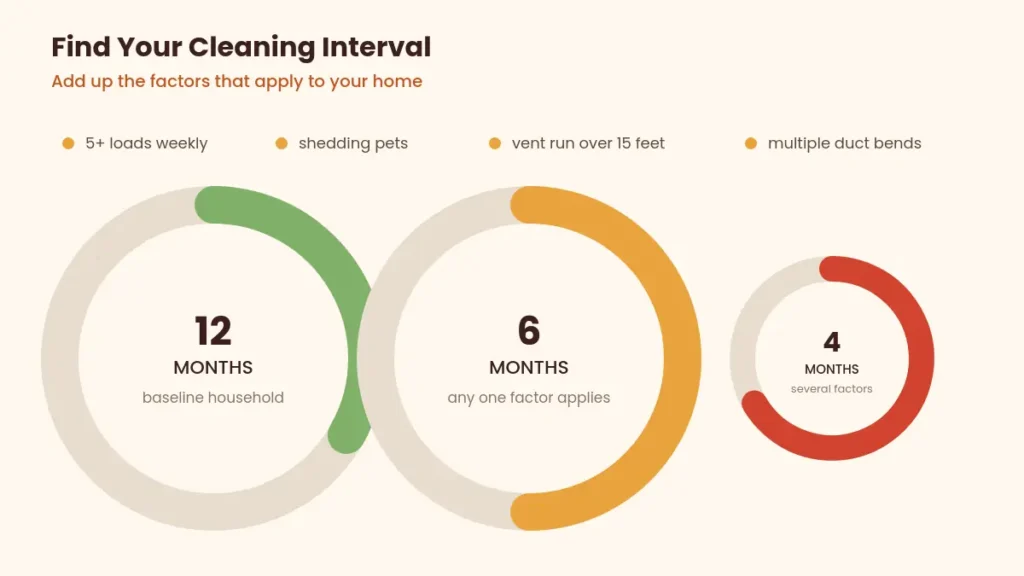
The once a year guideline works for an average household running three to four loads a week with a short, straight vent run to an exterior wall. Plenty of homes don’t fit that profile, and the schedule should shift accordingly.
Households running five or more loads weekly, common with larger families, should move to every six months. Homes with shedding pets need the same six month interval, since pet hair adds significantly to what accumulates in the duct beyond normal fabric lint. Long vent runs, meaning anything beyond about fifteen feet, or ducts with multiple bends and elbows, also warrant six month cleaning, since every turn in the path is a spot where lint naturally collects and builds up faster.
If your setup hits more than one of those factors, a family of five with a golden retriever and a basement laundry room with a twenty foot duct run, for instance, every four to six months is genuinely the right call rather than an overcautious one.
Warning Signs Your Vent Is Already Overdue
A schedule is useful, but your dryer will usually tell you when it needs attention before the calendar does. The single most common early sign is clothes taking noticeably longer to dry, particularly needing a second cycle for loads that used to finish in one. That’s the direct result of restricted airflow, the dryer physically cannot move moisture out of the drum fast enough.
- Clothes still damp after a full cycle, or needing two cycles regularly
- The dryer exterior or the laundry room feeling unusually hot during operation
- A burning or musty smell when the dryer is running
- Visible lint accumulating around the exterior vent opening outside
- Little or no airflow coming out of the exterior vent while the dryer runs
Any one of these means cleaning should happen sooner rather than at the next scheduled interval. A burning smell specifically means stopping the dryer and addressing it immediately, not finishing the load first. Worth noting that a dryer running without producing heat at all is a different problem entirely with its own set of causes, which we covered in detail in our guide on why a dryer runs but does not produce heat.

Why Michigan Homes Face Extra Risk Factors
A few things about Michigan housing and climate genuinely change the math here compared to other parts of the country.
Basement laundry rooms are extremely common across the state, and basement installations almost always mean a longer vent run with more bends to reach an exterior wall or roof line. Every additional foot and every ninety degree elbow is another opportunity for lint to catch and build up, which is why basement setups often need cleaning more frequently than a first floor laundry room venting straight out a nearby wall.
Cold winters add a second factor. When outside temperatures drop well below freezing, moisture in the warm exhaust air can condense inside the duct near the exterior opening, and damp lint packs together far more densely than dry lint does. That compacted buildup restricts airflow faster and is harder to clear than the loose accumulation you’d find in warmer months. Homes with exterior vent flaps that freeze partially shut compound the problem further.
Older housing stock across the state sometimes means vent ducts made of the flexible plastic or foil material that was common decades ago but is no longer recommended, since those materials sag, trap more lint in the low spots, and are themselves more combustible than the rigid metal ducting used today. If your home hasn’t had its dryer vent evaluated in years, checking what material the duct is made of is worth doing alongside the cleaning itself.
What a Professional Vent Cleaning Actually Involves
A proper cleaning goes well beyond emptying the lint trap. A technician disconnects the dryer from the duct, runs a rotating brush system through the full length of the vent line to dislodge compacted lint along the interior walls, and uses a vacuum to extract everything that gets loosened rather than just pushing it further down the line. The exterior vent hood gets cleared and checked to confirm the flap opens and closes freely, and the connection point behind the dryer gets inspected for crushing or kinking.
Professional dryer vent cleaning typically runs $100 to $200 depending on the length and complexity of the duct run. That’s meaningfully less than the cost of a single avoidable repair caused by an overheating dryer, and obviously not remotely comparable to the cost of a fire.
One thing worth understanding is why consumer brush kits often fall short on longer runs. Those kits push a brush through the duct, which does dislodge some lint, but without simultaneous vacuum extraction a meaningful portion of what gets loosened simply migrates further down the line and recompacts somewhere else. On a short, straight run venting through a nearby exterior wall, that’s usually fine. On a twenty foot basement run with three elbows, it frequently means the buildup just relocates rather than leaves, which is why the problem seems to return quickly after a do it yourself attempt.
If you’re outside our Michigan service area, our partner site Littleton Vent Guard provides the same professional dryer vent cleaning service for homeowners in the Littleton, Colorado area.
What You Can Do Between Professional Cleanings
- Clean the lint trap before or after every single load, without exception
- Vacuum the lint trap housing itself every few months, not just the screen
- Check the exterior vent opening periodically for lint buildup or a stuck flap
- Pull the dryer out once or twice a year and check the duct behind it for kinks
- Avoid overloading the dryer, which forces longer run times and more lint shed
These habits don’t replace a full duct cleaning, but they meaningfully slow how fast buildup accumulates between professional visits and give you a chance to spot a developing problem early. The lint trap one in particular is worth being genuinely strict about, since it is the single easiest habit on the list and catches the largest volume of lint before it ever reaches the duct.
Signs Your Vent Duct Itself Needs Replacing, Not Just Cleaning
Sometimes cleaning isn’t enough on its own. Flexible foil or plastic ducting should be replaced with rigid or semi rigid metal ducting, since the older materials sag and trap lint in ways that make recurring buildup nearly inevitable. Ducts that are visibly crushed behind the dryer, or that have separated at a joint and are venting into a wall cavity or crawl space rather than outside, need correcting immediately, since that’s both a fire hazard and a serious moisture problem for the structure.
A technician doing a cleaning will typically flag any of these issues during the visit, which is one practical advantage of having it done professionally rather than attempting the full duct run yourself with a consumer brush kit. Duct replacement itself is usually a straightforward job, generally $150 to $350 depending on the length of the run and whether the path needs to be rerouted, and it permanently eliminates a category of recurring buildup problems rather than treating the symptom every six months indefinitely.
Frequently Asked Questions About Dryer Vent Cleaning
How often should you clean a dryer vent?
Once a year covers most average households. Move to every six months if you run five or more loads weekly, have shedding pets, or your vent duct runs longer than about fifteen feet or includes multiple bends. Homes with several of those factors should consider every four to six months.
What happens if you never clean your dryer vent?
Lint accumulates until airflow is severely restricted, which forces the dryer to run hotter and longer, wearing out heating components prematurely and creating genuine fire risk. Failure to clean is consistently identified as the leading cause of dryer related residential fires.
Can I clean my dryer vent myself?
Cleaning the lint trap and the accessible section of duct behind the dryer is reasonable to do yourself. Cleaning the full duct run, especially on longer basement installations with multiple bends, generally requires a rotating brush system and vacuum extraction that professional services use to actually remove lint rather than compact it further down the line.
Does a longer drying time always mean the vent is clogged?
Longer drying times are the most common symptom of a restricted vent, but they can also point to a failing heating element, thermostat, or thermal fuse inside the dryer itself. If a fresh vent cleaning doesn’t resolve the problem, the cause is likely internal and worth having a technician diagnose.
How much does professional dryer vent cleaning cost?
Most professional cleanings run $100 to $200 depending on duct length and complexity. Homes with unusually long runs, roof venting, or ducts requiring replacement will land at the higher end or involve additional cost for the duct work itself.
Keep the Schedule and Skip the Risk
Dryer vent cleaning is one of the rare home maintenance items where the cost is low, the schedule is simple, and the consequence of skipping it is genuinely serious. For most Michigan households, marking it annually and moving to every six months if any of the heavier use factors apply is all the planning it really requires.
Motor City Appliance Pros services dryers across Michigan every week, including homes in Warren and Taylor, with same day appointments and a 90 day warranty on every repair. If your washing machine needs attention at the same time, our technicians can often handle both in a single visit.