
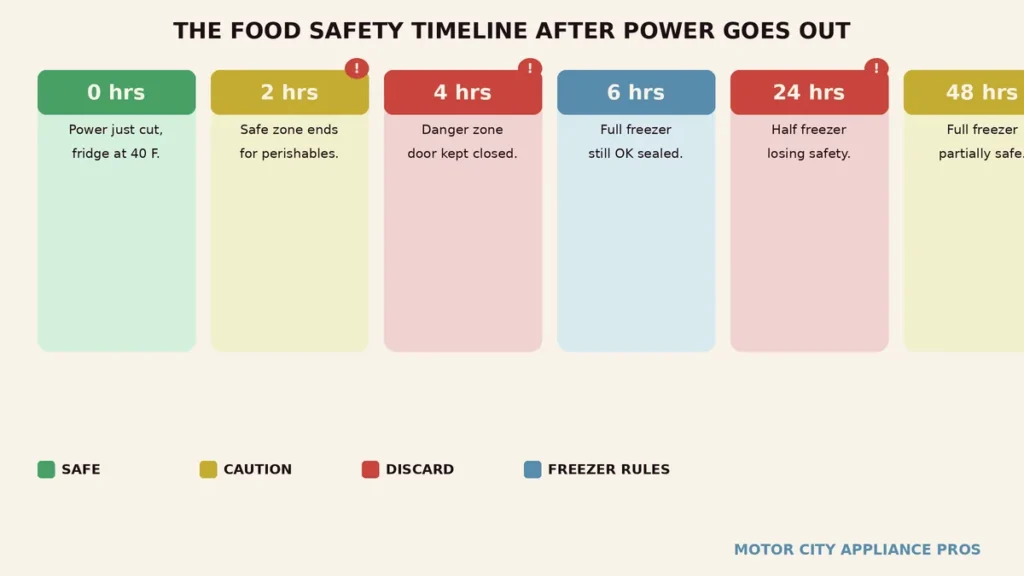
Food can safely stay in a refrigerator during a power outage for about four hours, as long as you keep the door closed the entire time. That four hour window applies to the fresh food section and assumes the fridge was at or below 40 degrees Fahrenheit when the power went out. Once that window closes, perishable food that hasn’t been moved to a cooler or cooked should be discarded.
Michigan residents know power outages better than most. A summer thunderstorm, a winter ice storm, a tree branch across a line, or a grid failure during extreme cold can cut power to a home for anywhere from a couple of hours to a couple of days. Knowing exactly what the clock means for your refrigerator is the difference between saving a week’s worth of groceries and throwing it all away, or worse, keeping food that isn’t actually safe to eat.
At Motor City Appliance Pros, we deal with the aftermath of power outages regularly, whether that’s a refrigerator that won’t restart after a power surge, a compressor damaged by an irregular voltage return, or a fridge that was warming up before the outage and now has to work twice as hard. This guide covers the food safety rules you need right now, and what to watch for with your appliance once the power comes back.
The Four Hour Rule for the Refrigerator
The four hour mark is the standard most food safety agencies agree on, and it assumes you treat your refrigerator like a cooler during the outage. That means keeping the door closed as much as possible. Every time you open the door, you let warm air in and accelerate the temperature rise inside the cabinet. A fridge that stays completely closed will hold its temperature significantly longer than one being opened every few minutes to check on things or grab a drink.
A full refrigerator holds its temperature better than a half empty one, since the cold food and drink already in there acts as thermal mass, absorbing heat before the air temperature rises. A mostly empty fridge, by contrast, has little to buffer the incoming warm air and will climb above 40 degrees faster. If you know a storm is coming, filling any empty space with jugs of water, which you can freeze beforehand to make them even more effective, buys meaningful extra time.
An appliance thermometer inside the fridge, ideally on the middle shelf, takes the guesswork out of this. If the temperature is still at or below 40 degrees Fahrenheit when the power comes back on, your perishables are safe. If it has climbed above 40, use the time estimates in this guide to decide what to keep and what to discard. If you don’t have a thermometer in there, the safest approach is to treat food as potentially unsafe after four hours with no power.
The Freezer Is a Different Story
Your freezer buys you much more time than the fridge section, and the rules depend on how full it is when the power goes out. A full freezer, packed edge to edge with food, will hold a safe temperature for roughly 48 hours with the door closed. A half full freezer holds its temperature for about 24 hours. The same principle applies here as with the fridge, more thermal mass means more buffer, and every door opening shortens the window.
If you have advance warning of a lengthy outage, like a major storm forecast, fill any empty space in the freezer with bags of ice or frozen water bottles before the power goes out. Even dry ice, if you can source it safely, can extend freezer safety for days. Handle dry ice with insulated gloves and make sure there’s ventilation in the space where the fridge sits, since it releases carbon dioxide as it sublimates.
A key rule for the freezer: food that still has ice crystals in it, or that is still at or below 40 degrees Fahrenheit, can generally be safely refrozen or cooked. Food that has completely thawed and has been above 40 degrees for more than two hours should be treated the same as any other perishable that crossed the danger zone. The exception is ice cream, which should not be refrozen once it has fully thawed, even if it’s still cold, since the texture and safety both suffer.
What Stays Safe and What Has to Go
Not everything in the refrigerator follows the same rules. Some foods are genuinely shelf stable even without refrigeration and will be fine. Others are much more sensitive and need to be discarded as soon as you have any doubt.
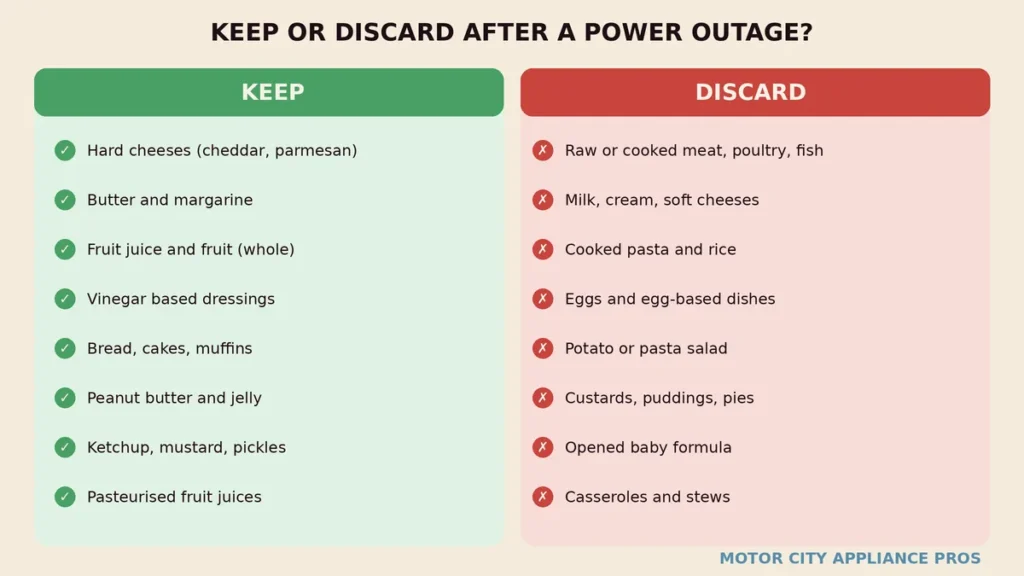
Hard cheeses like cheddar or parmesan are fine after a power outage as long as they don’t smell off or show visible mold. Butter and margarine are safe to keep. Whole fruits, fruit juices in sealed containers, vinegar based dressings, bread, peanut butter, jelly, mustard, ketchup, and pickles all survive a power outage without an issue. These foods don’t support rapid bacterial growth the way protein rich or dairy based foods do.
On the discard side, raw meat, poultry, and seafood need to go if you have any doubt about the timeline. Cooked meat and casseroles go as well once they’ve been above 40 degrees for more than two hours. Milk, cream, soft cheeses, and opened yogurt should be discarded after four hours above 40 degrees. Cooked pasta, rice, potato salad, and pasta salad are higher risk than many people expect because bacteria multiply quickly in those starchy, moist environments. Custards, puddings, pies with egg or cream filling, and anything containing mayonnaise as a primary ingredient should also be discarded. When in doubt, throw it out. The cost of a gastrointestinal illness far outweighs the cost of replacing groceries.
What Changes Hour by Hour
It helps to think about the outage in phases rather than treating it as a single all or nothing question.
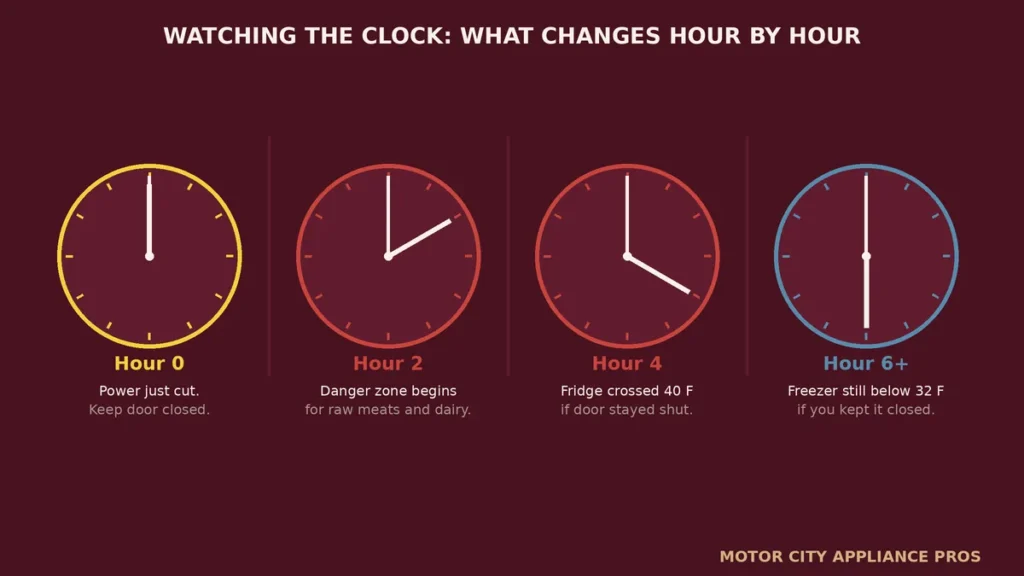
In the first two hours, the refrigerator is still in safe territory for most foods as long as the door stays closed. This is the time to do your planning, not your checking. Decide what you’d move to a cooler if needed, confirm the door is fully sealed, and leave everything alone.
Between two and four hours, the clock is running. The fridge is approaching the 40 degree mark. If you have a cooler and ice available, start moving the highest priority perishables, raw meat, dairy, and anything you’d be most upset to lose, into the cooler now rather than waiting to see how things develop.
At four hours, the standard guidance says perishables that have been sitting in a fridge at an unknown temperature should be treated as potentially unsafe. If your thermometer still shows 40 degrees or below, you’re still fine. If the thermometer reads above 40 and you don’t know exactly when it crossed that threshold, use conservative judgment.
Beyond four hours, the fresh food section should be treated with real caution on anything perishable. The freezer, however, continues to buy time as described above, especially if it’s full and hasn’t been opened.
Michigan Power Outages and Why They’re Especially Challenging
Michigan sees a wider range of outage scenarios than most states. Summer storms can knock out power quickly and restore it just as fast, leaving people with a short window to manage. But winter ice storms and major wind events can leave neighborhoods without power for twelve, twenty four, or even forty eight hours, and those are the situations where food safety decisions get genuinely hard.
In winter, Michigan homeowners have an advantage most others don’t: the outside air. If temperatures outside are at or below 40 degrees Fahrenheit, which is common from November through March across most of the state, you can use that cold air as a temporary refrigerator by placing perishable items in a cooler on the porch or in the garage. Keep a thermometer with the food and check it periodically. This works well for items that need to stay between 32 and 40 degrees. Don’t use this approach when outside temperatures are above 40, and be cautious about overnight lows that could actually freeze food you want to keep refrigerated rather than frozen.
Summer outages are harder because the ambient heat works against you from both sides: your fridge is already working to overcome a warm kitchen, and once the power goes out that warm air accelerates the temperature rise inside the cabinet. A cooler with ice becomes essential much sooner in a summer outage than in a winter one.
How to Handle the Food in Your Freezer During a Long Outage
If the outage is extending into the 24 hour range, you have a few options for the freezer that most people don’t think about until they’re already in trouble. First, if you have a gas grill, camp stove, or outdoor fire setup, cooking and eating the thawing food is a legitimate strategy. Meat that thaws but stays below 40 degrees is still safe to cook and eat, even if you can’t refreeze it.
Second, many Michigan areas have community centers, churches, or commercial facilities that open their doors during major outages, and some of those include refrigeration access for perishables. It’s worth knowing in advance whether your local area has such a resource, rather than scrambling to find one after twelve hours without power.
Third, if you have neighbors or family within a short drive who have power, moving your most valuable frozen food to their freezer is often the simplest solution during a prolonged outage. A car trunk in winter Michigan is cold enough to keep food below 40 degrees for the short drive in most scenarios.
What to Do When the Power Comes Back On
When power returns, resist the urge to restock the fridge immediately. Give the refrigerator thirty minutes to an hour to stabilize and confirm it’s reaching its normal temperature before loading it back up. Check the thermometer inside and make sure it’s reaching 40 degrees or below before you move perishables back in.
If the power went out during a period of extreme heat, or if your fridge was already running warmer than it should have been before the outage, this is a good moment to check that the fridge is actually reaching a safe temperature after the return. A refrigerator that struggles to cool after a power restoration might be dealing with a compressor issue worsened by the outage, a surge damaged control board, or a cooling system that was already on its way out.
Power surges on restoration are a real concern for refrigerators. A compressor that gets hit with a voltage spike at the moment power comes back can fail or develop a shortened lifespan from a single event. Surge protectors rated for appliances can help reduce this risk, and they’re worth having on any major appliance that’s plugged in year round. If your fridge won’t restart after a power restoration, or if it restarts but doesn’t cool properly, that’s the time to call a technician rather than waiting to see if it resolves itself.
Signs Your Refrigerator Was Damaged by the Outage
Most refrigerators survive power outages without any appliance damage at all. But a few warning signs after power restoration are worth taking seriously. If the fridge is running but the interior isn’t cooling to its normal temperature within a few hours of restoration, the compressor or cooling system may have been affected. If you hear a clicking or humming sound that keeps repeating without the compressor ever fully starting, the start relay may have been damaged by the surge. If the control panel shows error codes or is unresponsive, the control board may have taken a hit.
Our refrigerator repair team handles post outage compressor and control board issues regularly, with same day appointments and a 90 day warranty on all repairs. If the outage also affected your ice maker, which is connected to the same cooling system, our ice machine repair technicians can look at both in a single visit.
Refrigerator Repair After a Power Outage Across Michigan
Motor City Appliance Pros serves homes across the state, and our technicians carry the start relays, control boards, and compressor diagnostic tools that solve most post outage calls in a single visit. In the northern Detroit metro, our Macomb appliance repair team handles same day calls throughout that area. On the western side of the metro, our Southfield appliance repair technicians are available with the same same day service and 90 day warranty.
Wherever you’re located, you get a technician who checks whether the fridge is actually reaching safe temperatures, identifies any surge damage to the compressor or control board, and gives you a straight price before starting any work. A power outage is stressful enough without a broken appliance on top of it. We’ll get you back to normal as quickly as possible.
So, how long can food safely stay in a refrigerator during a power outage? Four hours in the fridge with the door closed, 24 to 48 hours in the freezer depending on how full it is. Keep the door shut, use a thermometer if you have one, and when the power comes back, give the fridge time to stabilize before you decide what to keep.
Frequently Asked Questions
Does it matter if the refrigerator was full when the power went out?
Yes, it matters quite a bit. A full refrigerator holds its temperature longer than a partially empty one because the food and drink inside act as thermal mass, slowing the temperature rise. A mostly empty fridge has little to buffer the incoming warm air and will climb past 40 degrees more quickly. If you anticipate an outage, filling empty space with water jugs or bags of ice helps extend the safe window significantly.
Can I eat food that smells fine after a long power outage?
Not necessarily. The bacteria that cause food borne illness, such as salmonella or certain strains of E. coli, typically don’t produce noticeable odors. A piece of chicken or a container of leftovers can smell and look completely normal while carrying enough bacterial growth to make someone very sick. When in doubt after a prolonged outage, discarding perishable food is the safer choice regardless of how it smells or looks.
What about medications that need to stay refrigerated?
Some medications, including insulin and certain liquid antibiotics, require refrigeration to maintain their effectiveness. If you take medication that needs to stay cold, keeping a small insulated medication case and a gel ice pack specifically for this purpose is a good practice before storm season. Contact your pharmacist or prescribing physician if you have any doubt about whether a medication was compromised during a power outage.
Is it safe to use the garage as a refrigerator in Michigan winters during a power outage?
It can be, with some care. If outdoor temperatures are between 32 and 40 degrees Fahrenheit, a garage or covered porch can serve as a temporary cold storage area. Use a cooler or insulated bag to protect food from direct sunlight or wind. Monitor the temperature with a thermometer rather than relying on the outdoor reading, since temperature can vary significantly inside a garage. Once outdoor temperatures drop below 32 degrees, you risk freezing food you intended to keep refrigerated, so monitor closely overnight.
Will my refrigerator be damaged if it runs at a warm temperature during a power outage?
The outage itself generally doesn’t damage the refrigerator, since the compressor is simply off during that period. The risk comes at restoration, when a voltage surge can stress or damage the compressor and control board. If your refrigerator doesn’t cool properly after power returns, or shows error codes, stop using it and contact a repair technician rather than continuing to run it and potentially worsening the damage.
How long before I need to call a technician if my fridge won’t cool after power returns?
Give the refrigerator one to two hours after power restoration to reach its normal operating temperature. If it’s still running warm after two hours, making unusual sounds, or showing control panel errors, it’s worth calling a technician that day rather than waiting. A compressor damaged by a surge won’t heal on its own, and running it while it’s struggling can deepen the damage.