
Your dishwasher still smells bad after you clean it because the odor almost never lives where you scrubbed. It comes from trapped food, grease, and stale water sitting in the filter, the drain path, the spray arms, or the door seal, and a quick wipe or a cleaning tablet never reaches those spots.
If you’ve been asking yourself why does my dishwasher smell bad even after cleaning it, you’re in good company. It’s one of the most common things Michigan homeowners tell us, whether they’re calling from a bungalow in Detroit, a colonial in Grand Rapids, or a lake house up north. They run the tablet, wipe down the door, splash some vinegar around, and open the machine the next morning to the same sour, musty, or eggy smell drifting out. It’s frustrating, and it’s easy to assume the machine has given up on you. Most of the time it hasn’t.
At Motor City Appliance Pros, we open up dishwashers every day, and the cause is usually something small and fixable. This guide walks through every real culprit we find in Michigan kitchens, how to narrow it down by the type of smell, and how to fix each one with tools you already own. We’ll also talk about the point where a smell stops being a cleaning problem and turns into a repair problem, because sometimes it does.
Why the Smell Survives a Cleaning
A dishwasher looks spotless inside, all shiny steel or clean white plastic. But think about what it really is: a warm, wet, dark box that stays shut for most of the day. That’s about as friendly to bacteria and mold as it gets. Tiny bits of food slip past the filter, grease cools and hardens on surfaces, and together they form a slimy layer called biofilm. Biofilm clings to whatever it lands on and shields the bacteria living inside it.
When you wipe the door and the tub walls, you remove the surface layer where you can see and reach. The biofilm packed into the filter, the spray arm holes, the sump, and the hoses stays right where it was. A cleaning tablet or a cup of vinegar helps dissolve some of it, but chemicals can’t do much if a physical clog is holding a pool of dirty water in place. The cleaner just runs around the problem.
Picture your kitchen sink. You can scrub the basin until it gleams, but if the smell is coming from the pipe underneath, the basin was never the issue. Your dishwasher has its own version of that pipe, actually several of them, and the smell rises into the tub every time you open the door. So the fix is rarely to clean harder. The fix is to clean the right spot. Here’s where we check, in the order that solves the most cases.
Start With the Filter, Because It Is Almost Always the Culprit
Most modern dishwashers have a filter sitting at the bottom of the tub, right under the lower spray arm. A surprising number of owners have never seen it. Manufacturers designed it to be pulled out and rinsed, and skipping that job is the single biggest reason a dishwasher smells after cleaning. Food gets trapped on the mesh, sits in warm damp air, and rots. Every cycle then pushes fresh water through that mess and spreads the smell around the whole tub.
To check yours, pull out the bottom rack and look at the floor of the machine. You’ll usually see a round cylinder that twists counterclockwise and lifts out, sometimes with a flat mesh screen underneath it. Take both out and look closely. Slimy debris, a gray film, or bits of food you don’t remember washing mean you’ve found your smell. Scrub the parts with warm soapy water and an old toothbrush, rinse them under the tap, and pay attention to the tiny holes in the screen, since those clog first.
While the filter is out, shine a flashlight down into the sump, the little well underneath. We regularly find a toothpick, a shard of glass, a fruit sticker, or a bottle cap sitting there. Anything you can lift out by hand should come out. Snap the filter back in until it locks, because a loose filter lets debris slide straight into the drain pump. If your dishwasher has a built in grinder instead of a removable filter, you can’t pull it, so move on to the drain path below.
Follow the Water Down the Drain Path
Once the wash is done, dirty water leaves through the sump, the drain pump, and the drain hose, then heads to your sink drain or garbage disposal. Every stop along that route is a chance for water or debris to hang around. The diagram below shows the path and marks the spots where we find smells most often.
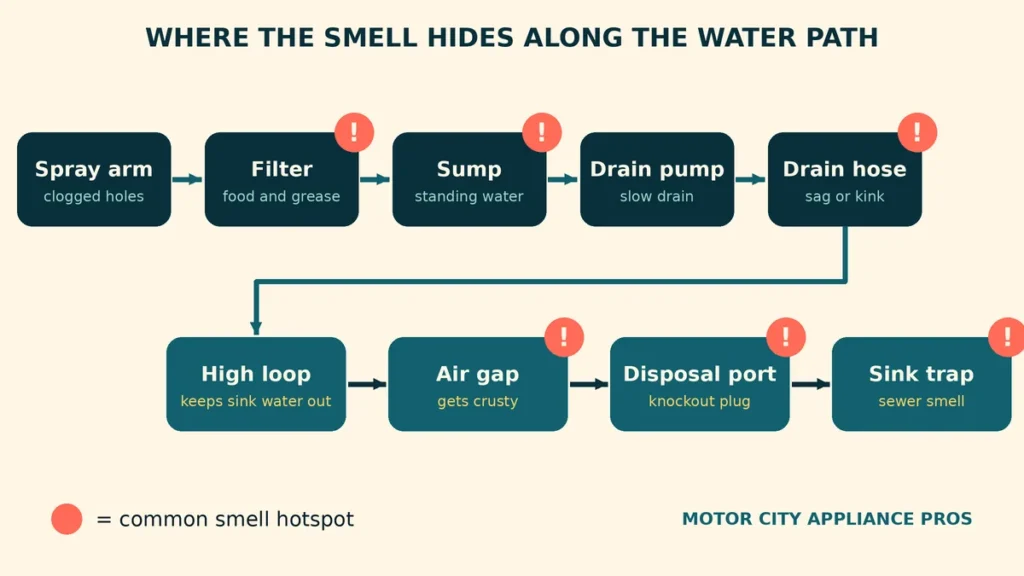
The drain hose is the first thing to look at. It runs under your sink, and it should never sag below its connection point, because a dip in the hose holds a pocket of dirty water that never leaves. Kinks are just as common. Somebody reorganizes the cabinet, pushes a bucket or a box of cleaning supplies against the hose, and now it’s pinched. Open the cabinet with a flashlight and follow the hose from the machine to the drain. If it’s crushed or drooping, straighten it out and support it.
You also want to see something called a high loop. That’s where the hose rises to the underside of the countertop before it drops down to the drain. The loop keeps dirty sink water from flowing backward into the dishwasher. If it has come loose or was never installed, gray water from the sink can slide back into the tub, and no amount of cleaning will beat that. Some homes use an air gap instead, a small chrome or plastic cylinder near the faucet. Those get crusty inside over time, so lift the cap and clean it out.
Here’s a quick test that tells you a lot. After a finished cycle, look at the bottom of the tub. A thin film of water or a spoonful in the sump is normal. A cup or more of murky water sitting there means the machine isn’t draining fully, and that standing water is your smell.
The Garbage Disposal Connection Nobody Thinks About
In many Michigan kitchens, the dishwasher drain hose connects straight to the garbage disposal. That connection causes two sneaky problems. The first happens with new disposals. They ship with a small plastic knockout plug blocking the dishwasher inlet, and if the installer never punched it out, the dishwasher can’t drain properly. It sounds like something you’d notice right away, but partial blockages create slow drains and lingering smells for months.
The second problem is packed food. Even with the plug gone, the short inlet fitting on the disposal collects rice, grease, coffee grounds, and pasta. It becomes a little stink pocket right next to your dishwasher’s drain. If you’d like to check it, put towels and a shallow pan under the sink, loosen the hose clamp, pull the hose off the fitting, and clear it with a spoon handle or a bent piece of wire. Then reattach it firmly.
One more clue: if the smell gets stronger when you run the disposal, the disposal is probably your real problem, and the dishwasher is just the messenger. Grind some ice cubes, flush it with plenty of cold water, and scrub the rubber splash guard with soap. Then run the dishwasher again and see if the odor changed.
Spray Arms and Other Hidden Gunk Zones
Spray arms have small holes that shoot water at your dishes. Food seeds, bits of label paper, and mineral scale plug those holes fast. Blocked holes leave dishes gritty, and the trapped debris inside the arm sits and rots between cycles. You can usually lift the lower arm straight off and unscrew or unclip the upper one. Shake each arm out, flush it under the tap, and poke every hole clear with a toothpick or a straightened paper clip.
Then take a flashlight and inspect the spots people forget. The detergent and rinse aid dispensers can grow a sticky film. The silverware basket often has slime in the bottom corners. The tracks the racks roll on collect crumbs. The top edge of the tub, right where the door closes, catches splashes that never get rinsed by the spray. Wipe each one with hot soapy water. Ten minutes of this often does more than a dozen cleaning tablets.
The Door Gasket and Lower Door Edge
The rubber seal around the door keeps water inside, and the folds in that rubber are perfect little cups for moisture and food. If you see black or pink spots, that’s mold or bacteria. Run a cotton swab or an old toothbrush along the folds with warm water and dish soap, wipe the whole seal, and dry it with a clean towel.
Don’t stop at the gasket. The bottom edge of the door, the strip below the seal, gets splashed with greasy water and rarely gets touched. That strip is a favorite hiding place for a sour smell. After every cleaning, leave the door open a few inches for an hour or two so the tub can dry. Moisture is what feeds all of this, so drying out the machine takes away half the problem.
Michigan Water, Michigan Winters, and Why They Matter
Where you live in the state changes what’s likely going wrong. Water across much of Michigan runs moderately hard to hard, and hard water leaves mineral scale on spray arms, heating elements, and tub walls. Scale feels rough under your finger, and that roughness gives biofilm something to grab. If your glasses come out with a white cloudy film, you have hard water at work. A rinse aid helps, a water softener helps more, and a citric acid cleaning cycle every month or two keeps scale from building up.
Plenty of homes outside city water systems, from Livingston County to the Upper Peninsula, run on private wells. Well water can carry iron and sulfur, and sulfur gives off a rotten egg smell. Here’s a test worth doing: run the hot tap in your kitchen sink for a minute and smell the water itself. If it smells, your dishwasher is only reporting the news. In that case a water test and a filter or softener will do more than any dishwasher cleaner ever could.
Winter matters too. Between the cold incoming water and the long pipe run from the water heater, the first water into your dishwasher can be barely warm, especially in a basement kitchen or a cold outer wall. Lukewarm water doesn’t dissolve detergent or grease well, so grease clings and starts to smell. Run the kitchen tap until the water turns hot before you start a cycle in cold months. And in humid Michigan summers, a closed machine stays damp for days, so crack the door open.
What Does Your Smell Actually Tell You?
Different smells point to different causes, and paying attention can save you an hour of guessing. A musty or moldy smell usually means a damp gasket, a dirty filter, or a machine that stays sealed shut all day. Check the door seal and filter first.
A sour smell, like old milk or spoiled leftovers, means food is rotting somewhere. That’s nearly always the filter, the sump, or the drain hose connection. A rotten egg smell points to sulfur in your water, a dried out drain trap letting sewer gas creep up, or bacteria growing in a slow drain. If it only shows up when the sink drains, look at the plumbing rather than the appliance.
Then there are the smells you shouldn’t ignore. A fishy odor or a hot burnt plastic smell can mean a wire, a control board, or something melted on the heating element. That’s not a cleaning issue. Stop using the machine, turn off the power at the breaker, and call a technician. A strong chemical or soapy smell that hangs around usually comes from too much detergent, a leaking rinse aid dispenser, or a cleaner that never fully rinsed out.
A Step by Step Deep Clean That Actually Works
If you’d like to fix it yourself, this is the routine we recommend. Set aside about thirty minutes and grab a flashlight, a toothbrush, some paper towels, and a bowl.
- Empty the machine and slide the bottom rack out so you can see the floor of the tub.
- Pull the filter and mesh screen, scrub them in warm soapy water, and check the sump underneath for anything stuck.
- Remove the spray arms, flush them under the tap, and clear every hole.
- Wipe out the sump area by hand with paper towels, then pour a cup of hot water into the bottom and watch it drain. It should disappear steadily.
- Scrub the door gasket folds and the bottom edge of the door with a toothbrush and soapy water, then dry them.
- Look under the sink and check the drain hose for kinks, sags, and a proper high loop. Clear the disposal inlet if you can reach it.
- Put the parts back, then run an empty cycle on the hottest setting with a dishwasher cleaner or a cup of citric acid powder in a bowl on the bottom rack. Check your owner’s manual first, because some brands warn against repeated vinegar use on rubber seals. Never mix vinegar with bleach.
- Leave the door ajar overnight and run a short rinse cycle the next day.
The image below shows what you’re aiming for. On the left is a filter and sump the way we often find them, packed with grease and food and sitting in murky water. On the right is the same spot after a proper cleaning.
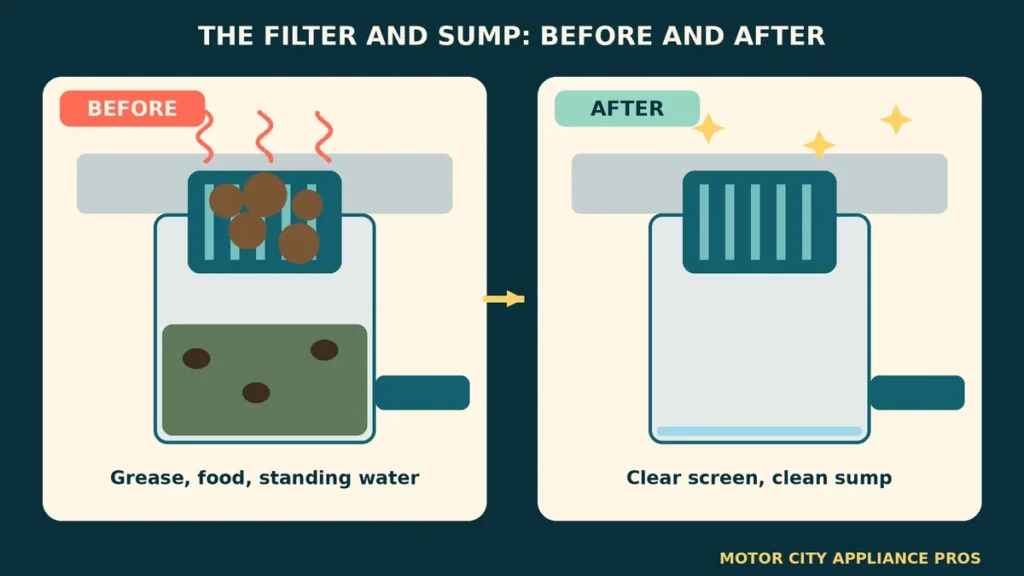
Give it a day or two. If the smell fades and stays gone, you’ve solved it. If it comes back within a few cycles, the problem is deeper than the tub, and it’s time to look at the drain path more seriously or talk to a technician.
Habits That Keep the Smell From Coming Back
A clean dishwasher stays clean when you build a few small habits around it. Scrape plates into the trash instead of the machine, but skip the heavy pre rinsing, since modern detergents work better with a little food to grab onto. Run the dishwasher regularly, because a machine that sits with dirty dishes for two or three days will smell no matter what you do. Let the kitchen tap run hot before starting a cycle, use the full amount of a good detergent, and add rinse aid if your water is hard.
After the cycle ends, prop the door open a couple of inches. Rinse the filter once a month, or every week if you cook with a lot of grease. And in hard water areas, run a citric acid cleaning cycle every month or two. None of this takes long, and it’s a lot cheaper than living with the smell.
When the Smell Is Really a Repair Problem
Sometimes you’ve done everything right and the odor keeps coming back. That usually means water is being held somewhere you can’t reach with a toothbrush. The ladder below shows how far to climb before you call someone. Start at the bottom, work up, and stop as soon as the smell goes away.
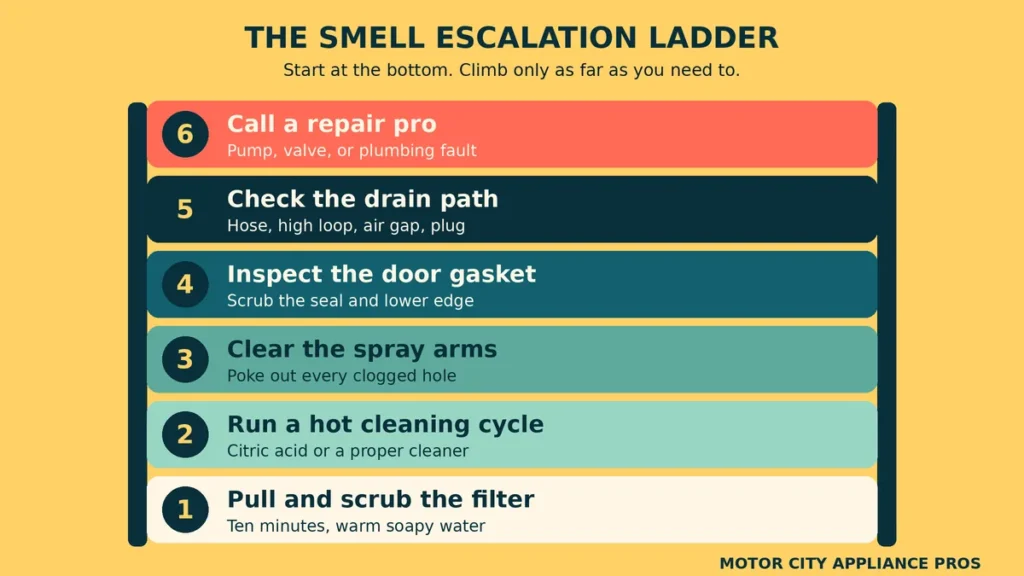
A few signs tell us the problem is mechanical. Standing water that won’t clear after you’ve cleaned the filter and checked the hose is the big one. Others include gurgling sounds during draining, a drain pump that hums but doesn’t push water out, error codes tied to draining, and water in the tub long after the cycle ends. A weak drain pump, a stuck check valve, a cracked drain hose, or a failing seal can all hold dirty water and let it stew. Those are jobs for a technician with the right parts on the truck.
Our dishwasher repair team handles drain pumps, check valves, hoses, spray arms, and every smell related fault we run into, and we offer same day service with a 90 day warranty on our repairs. If your laundry room has the same smell, the two problems can be related, especially when both machines share plumbing. In that case our washing machine repair technicians can look at both at the same visit.
Not sure whether a repair is worth it? Our guide to appliance repair costs and when to replace explains how we think about that decision. For a smell alone, replacement is almost never the answer. Most odor problems come down to a clog, a hose, or a cleaning gap, and they’re fixed for a fraction of the price of a new dishwasher.
Dishwasher Repair Across Michigan
Motor City Appliance Pros serves homes and rental properties across the state, and our technicians bring the common drain pumps, hoses, and seals with them so most visits wrap up in one trip. If you’re in the northern Detroit suburbs, our Southfield appliance repair team can usually get to you the same day. In the downriver area, our Taylor appliance repair team covers you the same way.
Wherever you live, you get the same thing: a technician who explains what they found, shows you the problem, and gives you a straight price before any work begins. If you’ve followed the steps in this guide and the smell is still winning, give us a call. We’ll figure out where it’s hiding and get your kitchen smelling like a kitchen again.
So, why does my dishwasher smell bad even after cleaning it? Because the source is hidden, wet, and out of reach of a wipe or a tablet. Find the filter, follow the drain, check the seal, and you’ll almost always find the answer.
Frequently Asked Questions
Can a dirty filter really cause a smell after I’ve run a cleaning cycle?
Yes, and it’s the most common reason we see. A cleaning cycle can’t remove a thick layer of food and grease that’s stuck to the filter mesh, and the smell returns as soon as the machine sits closed. Pull the filter, scrub it by hand, and check the sump underneath. Most people are surprised by what they find.
Is it safe to use vinegar and baking soda to clean a dishwasher?
It’s generally fine on occasion, but it’s not the best tool. Vinegar can wear on rubber seals if you use it often, and baking soda does very little against grease. A citric acid cleaner or a dishwasher specific cleaning product works better on scale and buildup. Whatever you choose, check your owner’s manual, and never mix vinegar with bleach.
Why does my dishwasher smell like rotten eggs?
Rotten egg smells usually come from sulfur in the water, especially on private wells, or from sewer gas creeping up a dried out drain trap. Bacteria growing in a slow draining line can also produce it. Smell the hot water from your kitchen tap. If the tap smells too, the water is the source. If only the dishwasher smells, look at the drain path.
How often should I clean my dishwasher to prevent odors?
Rinse the filter about once a month, and every week if you cook greasy meals. Wipe the door gasket every couple of weeks, and run a citric acid or dishwasher cleaner cycle every month or two, especially if you have hard water. Keep the door slightly open after cycles so the tub can dry.
Can a bad smell mean my dishwasher is broken or leaking?
It can. A smell that comes with standing water, gurgling, slow draining, or a leak under the machine points to a mechanical problem like a weak drain pump, a stuck check valve, or a damaged hose. A fishy or burnt plastic smell is more serious and can point to electrical trouble. Turn the power off and call a technician.
Is a smelly dishwasher worth repairing, or should I replace it?
A smell alone almost never justifies a new dishwasher. Most odor problems are caused by clogs, hoses, or built up grime, and those cost far less to fix than to replace. Replacement starts to make sense when the machine is very old and has several problems at once, such as a failing pump, a rusted tub, and leaks. We’ll give you an honest opinion on the spot.