
Should you repair or replace an appliance really comes down to one comparison: what the repair costs against what a new unit costs, adjusted for the appliance’s age. In most Detroit homes, if a repair quote sits under half the price of a new comparable appliance and the unit is less than ten years old, fixing it is the smarter move. Once that repair cost climbs past the halfway mark, or the appliance has already broken down more than once this year, replacement usually saves more money over time. Older housing stock across Detroit, Warren and the surrounding suburbs adds its own wrinkle to this math, which is exactly what this guide walks through.
This decision trips up more homeowners than it should, mostly because a repair quote in isolation does not tell you much. Fifty dollars is very different than five hundred, and five years old is very different than fifteen. The sections below break the decision down by appliance, by age, and by the specific challenges that come with Detroit’s older housing stock.
The 50 Percent Rule, Explained in Full
The rule technicians use most often is straightforward: divide the repair quote by the cost of a new, comparable appliance. If that number is under 50 percent, repair. If it climbs above 50 percent, replace. A $200 repair on a $900 refrigerator is 22 percent, an easy repair decision. A $500 repair on the same fridge is 56 percent, and now replacement deserves serious consideration.
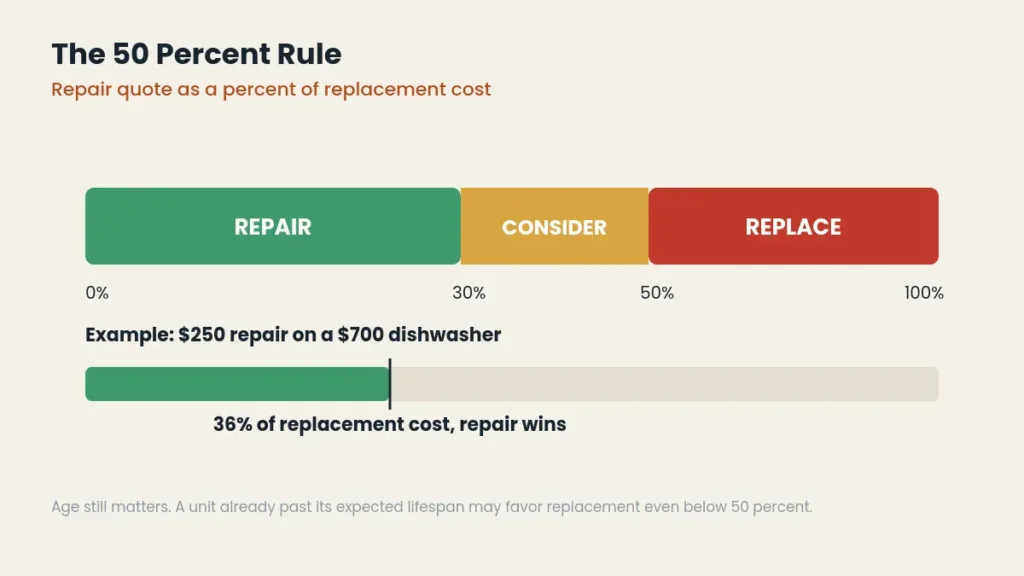
The 50 percent rule for deciding whether to repair or replace an appliance
This rule works as a starting point, not a strict law. A appliance at 40 percent of replacement cost but nearing the end of its expected lifespan is a different call than the same percentage on a three year old unit. Age and repair cost need to be weighed together, not separately.
Why Appliance Age Matters as Much as the Repair Bill
Every major appliance has an expected lifespan, and that number should sit right next to the repair quote when you’re making this decision. Refrigerators typically last 10 to 15 years, washing machines and dryers around 10 to 13 years, dishwashers closer to 9 to 12 years, and ovens can often stretch past 15 years with basic care.
- Under 5 years old: repair almost always makes sense, even for a costly fix
- 5 to 8 years old: repair unless the quote exceeds 40 to 50 percent of replacement cost
- 8 to 12 years old: replace if the repair exceeds 30 to 40 percent of replacement cost
- Past 12 years old: lean toward replacement unless the fix is minor and cheap
An appliance that has already needed two service calls in the past year is telling you something even if each individual repair was affordable. Recurring failures usually mean the unit is entering its final stretch, and the next fix is rarely the last one.
Why Older Detroit Homes Change the Calculation
Detroit and its inner suburbs have a lot of housing built between the 1920s and 1970s, and that older construction affects appliance decisions in ways newer subdivisions do not. Electrical panels in these homes were often not designed for the higher draw of modern high efficiency appliances, which can mean an electrician needs to get involved before a replacement unit is even installed. That added cost sometimes tips the math back toward repairing the appliance you already have.
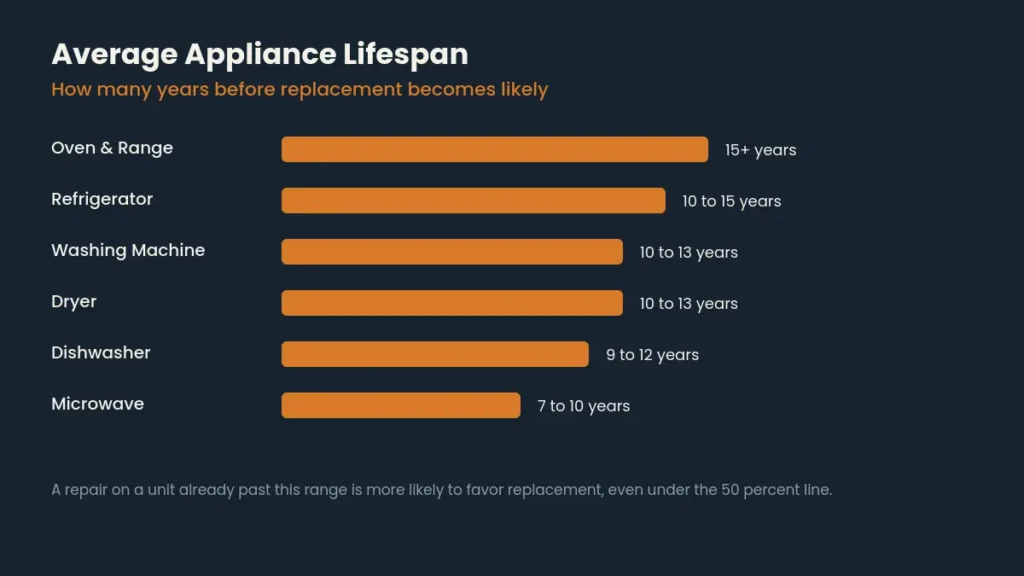
Average appliance lifespan by type before replacement becomes likely
Tight kitchen and laundry footprints are another factor. Many older Detroit bungalows and colonials were built around appliance dimensions from decades ago, so a modern replacement refrigerator or washer may not fit the existing space without cabinetry work. In neighborhoods like Warren, where a large share of homes date back several decades, this space mismatch comes up often enough that many homeowners choose to repair an older appliance simply to avoid a larger renovation.
Newer construction in areas like Farmington Hills tends to face the opposite issue: appliances there are often higher end, built in models where parts and labor cost more, which can push the repair versus replace math closer to the 50 percent line even on a relatively young unit.
Refrigerator: Repair or Replace
A refrigerator repair under $300 on a unit less than eight years old is almost always worth doing. Compressor failures, which typically run $400 to $600, are the one exception worth pausing on: on a fridge past the ten year mark, that repair cost often crosses the halfway point of replacement value, making a new energy efficient model the better long term choice.
Washing Machine and Dryer: Repair or Replace
Washers and dryers are usually worth repairing throughout most of their lifespan, since parts tend to be affordable relative to a new unit. A drain pump, belt, or heating element replacement rarely crosses 30 percent of replacement cost even on a nine or ten year old machine. If your washing machine is having drainage or spin issues, or your dryer is not heating properly, a repair is worth pursuing first in almost every case, since board level failures are the main exception that pushes toward replacement on older units.
Oven, Dishwasher and Microwave: Repair or Replace
Ovens hold their value the longest of any kitchen appliance, and a control board or igniter repair is almost always the right call even on a twelve year old unit. Dishwashers sit in the middle, worth repairing for gasket, pump or valve issues, but a control board failure on a unit past nine years starts to favor replacement. Microwaves are the simplest case: since a new countertop unit often costs less than a major repair, replacement usually wins once the unit is out of warranty and the fix involves the magnetron.
Energy Costs Are Part of the Real Math
A ten year old refrigerator can use noticeably more electricity than a current ENERGY STAR model, and that gap adds up over a Michigan winter when the compressor runs longer to fight cold garage or basement temperatures where many Detroit area units sit. Older top load washers and electric dryers show a similar pattern, often using considerably more water and electricity per load than current models. When a repair and a replacement land close to the same price after accounting for a few years of higher energy bills on the old unit, that tips the decision toward replacing, even if the 50 percent rule alone would have said repair. This is less relevant on appliances under five years old, since efficiency gains between recent model years tend to be small.
Signs It Is Time to Replace, Regardless of the Rule
- The appliance has needed two or more repairs in the past twelve months
- Replacement parts are discontinued or take weeks to source
- The unit no longer meets your household’s needs, such as capacity
- A technician flags a safety issue, like a gas leak risk or exposed wiring
- The repair quote is close to 50 percent and the unit is already past its expected lifespan
Any one of these on its own is worth a serious conversation about replacement, even when the dollar amount of the repair looks small.
The same applies in cities like Philadelphia, where Philadelphia-based repair technicians report identical patterns in older housing stock.
What a Technician Actually Checks Before Giving You a Recommendation
A repair or replace recommendation should never be a guess. When a technician evaluates an appliance in person, they are looking at more than the single failed part. They check the overall condition of the unit, including rust, wear on the door seals, and how the motor or compressor sounds when it runs. They pull the model and serial number to confirm exactly how old the appliance is and whether parts are still in production.
They also factor in what else tends to fail around the same time on that specific model. A washing machine with a failed bearing, for example, often has a motor nearing the end of its life too, even if the motor has not failed yet. A technician who has serviced thousands of these units in Detroit homes can flag that pattern in a way a generic online repair cost calculator never will, which is the real value of an in person diagnostic over a guess made from a search result.
Frequently Asked Questions About Repair or Replace Decisions
Is it cheaper to repair or replace a refrigerator?
Repairing is cheaper in the short term for most fridges under ten years old, especially for common fixes like a door seal or thermostat. Once a repair, such as a compressor replacement, approaches half the cost of a new comparable unit, replacing becomes the better value over the following five to ten years.
How do I know if my appliance is worth fixing?
Compare the repair quote to the cost of a new comparable appliance and check the unit’s age against its typical lifespan. If the repair is under half the replacement cost and the appliance is under ten years old with no recent repair history, it is almost always worth fixing.
Do older homes in Detroit need special consideration for appliance replacement?
Yes. Homes built before the 1970s sometimes have electrical panels that were not designed for modern high efficiency appliances, and existing kitchen or laundry spaces may not fit newer appliance dimensions without extra work, both of which can add unexpected cost to a straightforward replacement.
What appliances are almost always worth repairing?
Ovens and washing machines tend to be worth repairing through most of their lifespan, since common parts are inexpensive relative to replacement cost. Microwaves are the opposite case, since a new unit is often cheaper than a significant repair.
Does a home warranty affect the repair or replace decision?
If an appliance is covered under a manufacturer or home warranty, repair is typically the right call regardless of age, since the cost to you is minimal. Once that coverage expires, the standard repair versus replace math applies.
Get an Honest Answer Before You Decide
The fastest way to know which side of this decision your appliance falls on is a straightforward, in person diagnosis from someone who has no reason to push you either way. A technician who repairs appliances for a living, rather than sells new ones, will tell you plainly when a fix is worth it and when it is not.
Motor City Appliance Pros has spent nine years helping Metro Detroit homeowners make this call with a straight answer rather than a sales pitch, backed by a 90 day warranty on every repair we recommend.